Incident
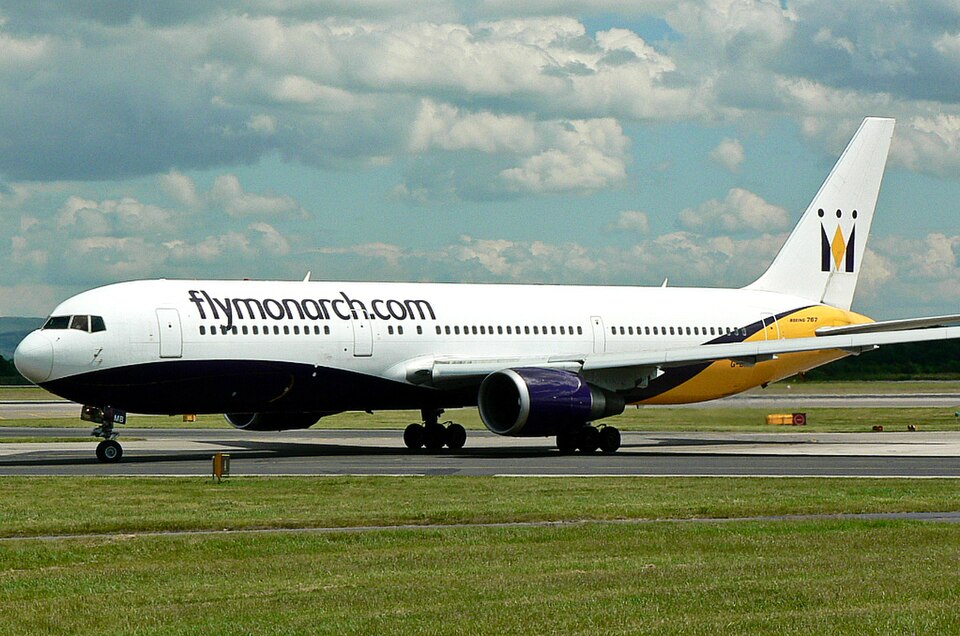
On 25 November 1998, a Boeing 767-31K (registration G-DIMB) operated a passenger flight from Las Vegas to Manchester International Airport. The aircraft carried 11 crew and 318 passengers. Upon arrival, baggage handling staff discovered that at least two LD2 containers had moved in flight and jammed in the rear hold and door area. One container had penetrated the ceiling of the hold and damaged the cabin floor structure above. No injuries were reported.
Investigation
The AAIB investigation found that the lateral guide stops at the forward edge of the baggage doorway, which prevent rearward movement of containers in flight, were retracted and manually latched down. The stops at the rear edge were extended. The centre guide plates between two rear pairs of containers were also retracted. The containers had been unloaded and guide stop mechanisms operated before examination, but photographs confirmed the stops' position.
Inquiry by the NTSB at Las Vegas revealed that during offloading from the inbound flight, loaders had manually safety-locked the guide stops into the retracted position to facilitate baggage removal. After a shift change, the outgoing shift did not inform the incoming shift that the stops were manually fixed. The incoming shift did not check the stops before closing the baggage door, so the failure to extend went unnoticed.
Damage
The ceiling liner at the rear edge of the doorway was punctured on the right side. A 1.5-metre section of the cabin floor support beam at station 1351 was buckled and fractured. The damage matched impact from a container top. The standby power system cable running along the beam's lower edge was damaged, with electrical arcing between the conductor and the beam web. Damage also occurred to the E6 aft equipment centre panelling, but the APU battery, controllers, and wiring within were intact. Several motorised guide stops in the doorway roller mat were broken, likely from being struck by container bottoms.
Discussion
Each loaded LD2 container can weigh over 700 kg, with a row of five exceeding 3.5 tonnes. With stops retracted, containers could roll back on take-off rotation. Left-side containers hit the extended rear stops without significant damage. Right-side containers struck projecting parts of doorway stops, fracturing them, and then rode over the debris, lifting enough to hit the ceiling and floor beam. While the beam damage did not seriously hazard the aircraft, the electrical arcing to the standby power cable posed a potential fire risk, especially near the APU fuel line on the left side. The report noted that impact damage to both cable and fuel line could cause a serious fire.
Safety Recommendations
The AAIB issued two recommendations to the FAA and Boeing:
- Consider local modifications to the standby power cable and adjacent fuel line at station 1351 on the left side to reduce impact damage risk from unrestrained containers.
- Consider a warning system or interlock to alert crew and handlers if lateral stops are incorrectly set, or to prevent door closure.