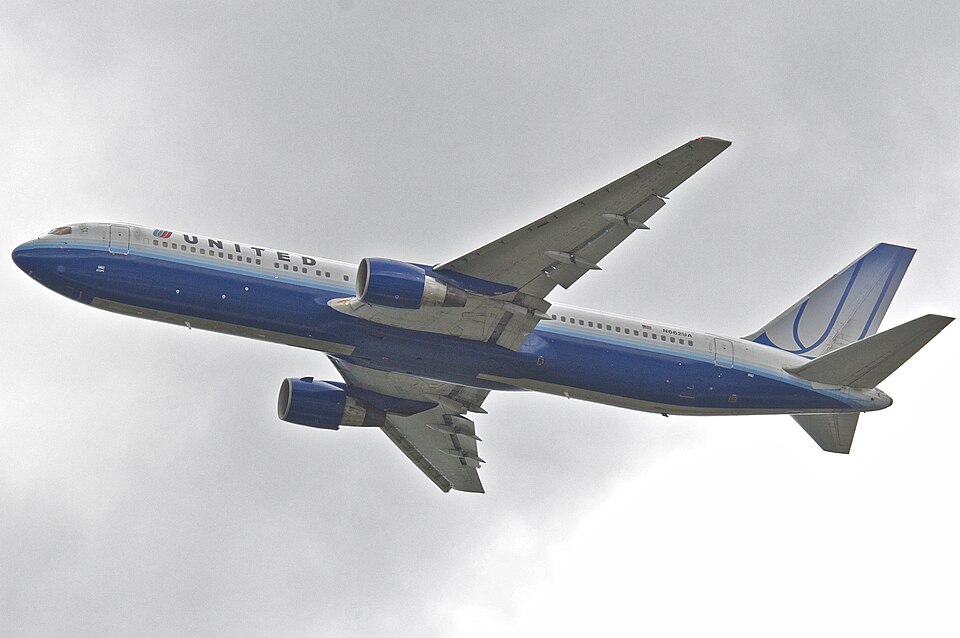
Incident
On 1 September 1998 at 0521 UTC, a Boeing 767-322ER (registration N662UA) operating a scheduled passenger flight from Washington Dulles arrived at London Heathrow Airport. The aircraft was on final approach to Runway 09L. At 0518 hrs, the crew contacted the Heathrow Tower Controller. Shortly after, a preceding landing aircraft reported a flock of geese to the right side of the runway heading toward Runway 09R. Another aircraft on approach to Runway 09R was advised. A Boeing 747 landed on Runway 09L without incident. At 0520 hrs, N662UA was cleared to land; surface wind was from 090° at 8 knots.
The commander reported that at about 50 feet above the runway, a flock of geese flew into the aircraft's path from right to left (northbound). This flock had not been sighted by anyone, although the pilot had heard transmissions about a southbound flock. The engines were at idle power, and the aircraft was one to two seconds from touchdown. At the end of the landing roll, the commander reported the bird strike and bird debris on the runway to the controller. Without immediate indications of engine damage, the aircraft taxied normally to stand K16.
Airport Response
The tower controller requested the Airport Operations bird control patrol vehicle to inspect the runway threshold. The driver reported bird debris requiring clearance, causing a subsequent aircraft to go-around. The driver also observed a flock of about 40 geese heading northbound. Runway 09L was closed for about one hour while debris from an estimated 25 to 30 geese was removed from blocks 113 and 114.
Airport operations staff were aware of intense Canada Goose activity. A Notice to Airmen (NOTAM) had been issued the previous day warning of possible geese flying below 500 feet. The Automatic Terminal Information Service (ATIS) at 0529 hrs advised of geese overflying the airport. The permanent bird control patrol (two trained personnel with a Land Rover) was near Runway 09L but east of the touchdown point; another vehicle patrolled near Runway 09R. Neither patrol had seen the flock involved.
Post-Accident Investigation
Inspection after taxi to the stand revealed extensive damage: the nose radome, left wing leading edge slats, and flaps; the left engine showed evidence of bird ingestion; also strikes on the left main and nose landing gears, left wing trailing edge flaps, and left stabiliser. Replacement of the radome, weather radar, No 4 outboard slat, and an anti-icing duct (ruptured at the No 5 slat) was required. A borescope inspection of the left engine found no core damage, but all fan blades were replaced.
The Airport Operations Safety Unit (AOSU) determined that Canada Geese were roosting at lagoons in the Perry Oaks complex (a disused sewage treatment works between the two main runways) and flying north off the airport. Off-airport searches confirmed feeding sites (one with over 500 birds) and roosting sites on nearby ponds and reservoirs, including one just outside the airport boundary. AOSU initiated a roosting deterrence programme at Perry Oaks and other airport-controlled areas but lacked authority and resources for off-airport sites.
Birdstrike Hazard Context
This accident occurred nine months after another birdstrike involving a Grey Heron and a Boeing 747 (G-AWNJ), which prompted safety recommendations about large waterfowl numbers near Heathrow. Canada Geese were identified as a serious hazard due to their size (1.5–7.5 kg), numerosity, and flocking nature. The Civil Aviation Authority commissioned a one-year study of the Canada Goose population around Heathrow, starting June 1999, to review engine certification criteria. Safety Recommendation 99-18 urged expanding the study to formulate management recommendations.
The incident confirmed that the resident goose population posed a specific air safety hazard. The Perry Oaks complex, situated between the western ends of the two runways, attracted waterfowl to a location of heightened threat. Historically, goose populations were migratory, but increasingly, Canada Geese become residential around airports, increasing collision risks during landing and takeoff. In the UK, native grey geese migrate to northern regions, but Canada Geese have established resident populations in the Heathrow area.