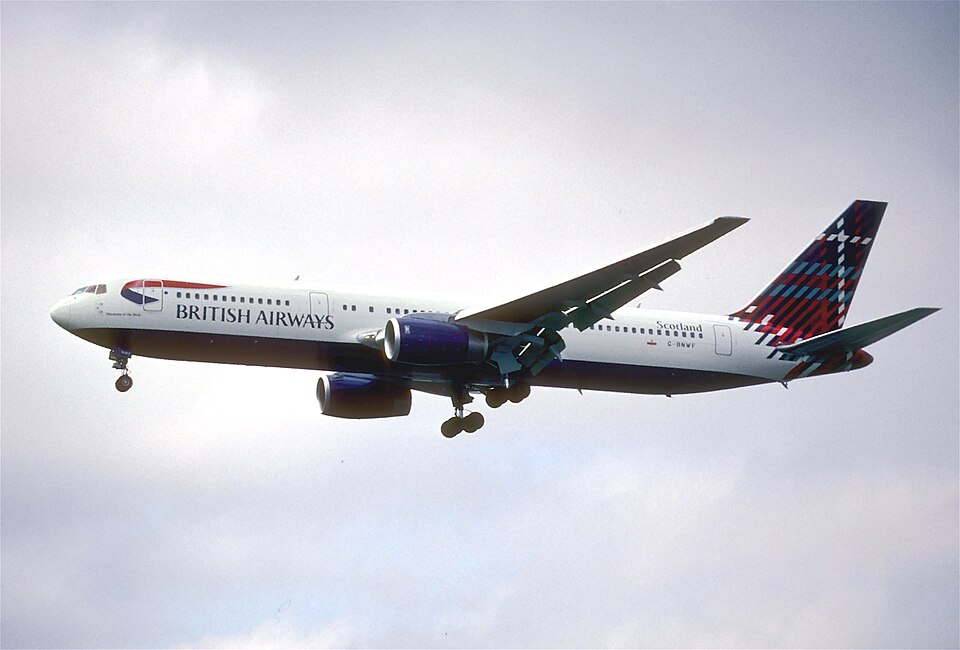
History of the Flight
The aircraft, a Boeing 767-336 registered G-BNWF, was operating a scheduled passenger flight to London Heathrow Airport. The landing runway was 09L with a dry surface. The commander, holding an Airline Transport Pilot's Licence with 11,200 total flying hours, performed a manual landing using flap 30 and autobrake set to level 3. Touchdown occurred at 136 kt, described as normal. At 94 kt, the autobrake was deselected and manual brakes applied. During taxi to the stand, brake use was normal except that the right rear brake temperature rose from level 3 to level 5 on EICAS. After passenger disembarkation, the crew noted right brake smoking and an 'RF' indication for the right hydraulic system, indicating low reservoir fluid.
Examination and Findings
Examination revealed that the brake reaction rod at the No 8 wheel (outboard rear wheel on the right main landing gear) had failed at its rod end attachment to the brake assembly. The brake assembly rotated with the wheel, rupturing hydraulic and electrical connections and causing hydraulic fluid loss. The rod remained attached at the landing gear leg centre bolt. Detailed fracture analysis showed an overload failure in tension with no pre-existing defects. Evidence indicated the rod had been subjected to fewer than ten cyclic loads approaching failure before separation. The brake housing bushing was ovalised in the load direction, confirming high loads. The No 8 brake hardware showed normal wear for its number of landings.
Flight Recorder Data
The Quick Access Recorder (QAR) confirmed the crew's account. After two to three seconds of manual braking at about 76 kt, brake pressures on both landing gears momentarily decreased. No unusual heading or acceleration changes were observed. No 8 brake temperature decayed to zero, and right hydraulic system fluid quantity began reducing slowly. During taxi, further brake applications caused additional fluid loss, and an overtemperature warning triggered for the No 7 brake as the aircraft turned onto the stand.
Previous Incidents
This incident was similar to over 20 previous brake reaction rod separations on Boeing 767 aircraft with carbon/carbon brakes worldwide since August 1992. The AAIB had investigated two incidents at Heathrow in September 1993, leading to a performance limitation due to risk of double brake failures. Prior failures involved center bolt failure or simultaneous brake unit failures. The problem emerged with carbon/carbon brake introduction and was attributed to high loads from a highly energetic vibration mode between fore-aft brake pairs and their reaction rods. Maintenance and hardware changes had appeared to eliminate the issue for British-registered aircraft, but failures occurred elsewhere. This was the first known failure of the rod's end cap, representing a new failure mode related to carbon/carbon brake dynamics.
Further Action
In summer 1998, the airframe and brake manufacturers certified an updated brake for the Boeing 767 family using a new carbon brake material similar to that used on the Boeing 777. Development flight testing indicated these brakes are less prone to damaging dynamic effects causing rod failures. The operator planned to equip its Boeing 767 fleet with the modified brake assemblies.