Synopsis
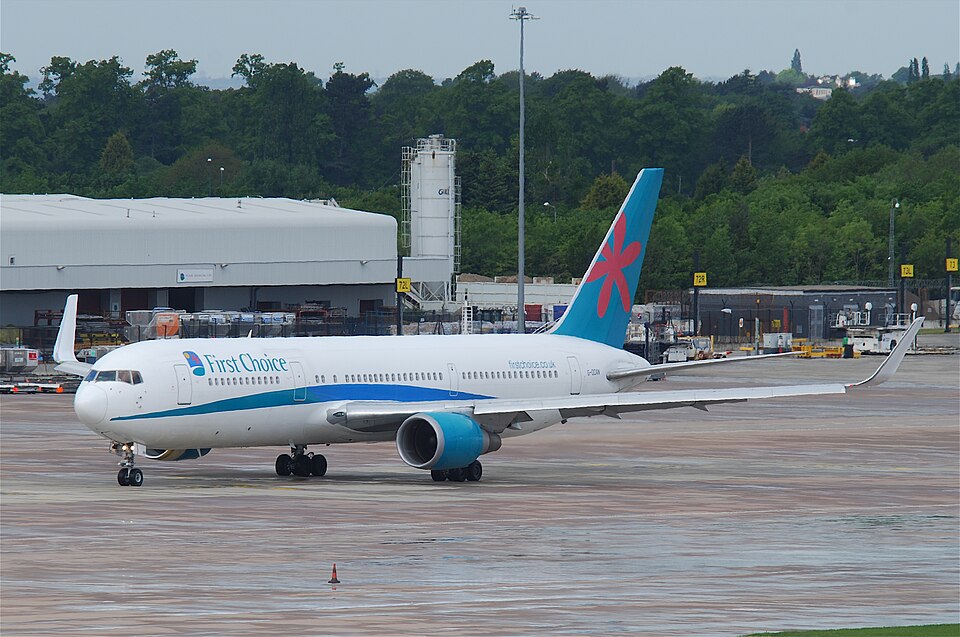
On 13 December 2008, a Boeing 767-39H, registration G-OOAN, operated as a commercial passenger flight from Manchester Airport to Montego Bay, Jamaica, experienced a tailstrike during takeoff from Runway 23L. The incident occurred because the zero fuel weight (ZFW) was mistakenly entered into the operator's Computer Takeoff Programme (CTOP) instead of the actual takeoff weight (TOW). This produced takeoff speeds approximately 20 knots lower than required. The aircraft sustained minor paint damage to the tailskid and returned to Manchester for an overweight landing without further incident. There were no injuries to the 11 crew members or 254 passengers.
History of the Flight
The flight crew, based at London Gatwick Airport, consisted of a commander (age 46, with 11,534 total flying hours, including 3,926 on type) as pilot not flying and a co-pilot as pilot flying. Prior to boarding, the crew telephoned the handling agent with trip information required for the loadsheet. Once on board, the dispatcher requested the previously provided figures. The crew entered all necessary data into the CTOP except the TOW, which required the loadsheet. When the loadsheet arrived at the standard departure time, the incorrect TOW was entered into the CTOP, and the calculated takeoff speeds and thrust reduction were programmed into the Flight Management Computer.
Pushback occurred 15 minutes late. During taxi, heavy rain began, requiring engine anti-ice to be selected on. The co-pilot recalculated takeoff speeds using the CTOP while taxiing and reported no changes. During the takeoff roll, the commander delayed the V1 call by approximately 10-15 knots due to perceived sluggish acceleration, suspecting the aircraft was heavier than calculated. The co-pilot rotated slowly, and the TAILSKID message illuminated momentarily on the Engine Instrument and Crew Alerting System, indicating a tailstrike. The commander applied full power, and shortly thereafter the stick shaker activated briefly. The co-pilot reduced pitch while maintaining a positive climb rate. The aircraft climbed away safely, and the after-takeoff checklist was completed. Air Traffic Control was informed and confirmed no debris on the runway. The Quick Reference Handbook checklist for the TAILSKID message was executed, fuel was dumped, and the aircraft returned to Manchester for an overweight landing. Engineering checks lasting 20 minutes found only a thin layer of paint scraped from the tailskid, and the aircraft was declared serviceable.
Pilot Comments
The commander noted that he had flown approximately six empty sectors in the Boeing 767 prior to this flight, which may have desensitized him to the slow takeoff speeds. As he was not based at Manchester, he paid particular attention to taxi routing due to work in progress on taxiways. This diversion of attention, combined with the co-pilot checking takeoff speeds, contributed to the oversight. He also mentioned that the delayed pushback created time pressure. After landing, the commander checked the CTOP and immediately realized that the ZFW had been entered instead of the TOW. He commented that the Flight Management Computer would have correctly calculated the TOW by summing ZFW and fuel data, which would have ensured correct flap maneuvering speeds. The co-pilot concurred with the commander's remarks.
Safety Actions
Following the incident, the crew received additional training on the CTOP and successfully completed a line check. The operator issued a notice to all pilots emphasizing that both pilots must independently extract the Actual Take Off Mass (ATOM) from the loadsheet when conducting performance calculations, and that masses written on the Operational Flight Plan should not be used. The operator also announced an amendment to Operations Manual Part A, procedure 8.20.2.6, to include that both pilots should independently extract the ATOM from the loadsheet and perform the CTOP calculation, with the pilot flying calling out any further assumptions. The notice reminded pilots of the need to manage commercial and time pressures without compromising safety.
Supporting Information
The incident highlighted the potential for error when using the CTOP or similar performance programs. In this case, the incorrect entry of ZFW instead of TOW resulted in takeoff speeds that were about 20 knots lower than correct values. The correct V1, VR, and V2 for the actual takeoff weight of 172,351 kg were 143, 154, and 160 knots respectively, while the incident speeds were 124, 133, and 138 knots.