History of the Flight
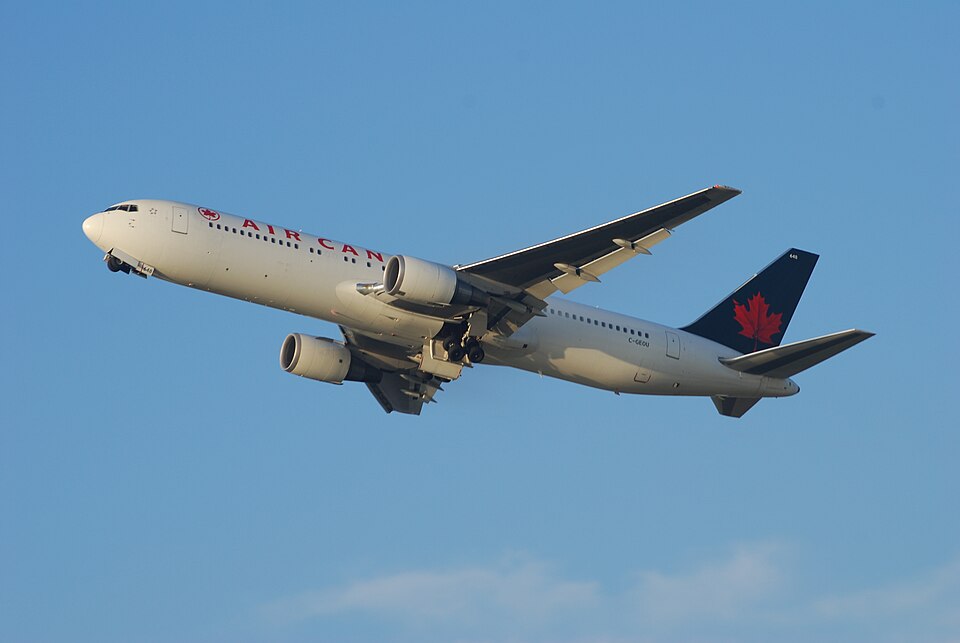
The aircraft, a Boeing 767 (C-GEOU), had arrived from Calgary, Canada, with three operating crew and 90 passengers. After landing and taxiing onto Taxiway Golf at London Heathrow Airport, the aircraft was unable to proceed onto Stand 329 because no handling agent was present to activate the stand guidance system. An airport staff member marshalled the aircraft onto the stand. The commander reported that after being signalled to stop by the marshaller, he believed he set the parking brake correctly by depressing the toe brakes and pulling the parking brake T-handle. The engines were shut down and the hydraulic pumps turned off. The handling agent had not arrived, so an attempt was made to contact him by radio. Passengers were asked to remain seated.
Approximately 10 to 15 minutes later, the aircraft began to roll forward slowly. Initially the crew thought the pier was moving, but the commander soon realized the aircraft was moving and gaining speed. He applied the toe brakes and noticed the parking brake T-handle was retracted. The co-pilot turned on the hydraulic pumps due to low accumulator pressure. The aircraft stopped just as the left engine made contact with the pier, but no impact was felt by cabin crew or passengers. The aircraft had rolled 12 feet before the left engine nose cowl struck the pier.
Damage Assessment
The maintenance organization measured a dent on the left engine nose cowl of 7 inches across and approximately 1 inch deep. The left engine nose cowl was replaced before the next flight. The braking and hydraulic systems were checked and found serviceable.
Stand Characteristics
Stand 329 at London Heathrow is equipped with a Parallax Aircraft Parking Aid (PAPA) board and Azimuth Guidance for Nose-In Stands (AGNIS). There is no STOP sign on the PAPA board; a flashing red STOP sign is fixed to the terminal fascia ahead of the centreline but is not intended for routine use. The airfield operating company stated that the design standard for stand gradient should not exceed 1% in any direction; the gradient on Stand 329 was approximately 0.42% towards the terminal.
Discussion
The aircraft rolled forward because the parking brake was not correctly set and no chocks had been placed under the wheels. The commander voluntarily reported that the incident was caused by his failure to set the parking brake correctly. The marshaller left the area without placing chocks. Chocks are not normally visible from the flight deck, highlighting the importance of crew monitoring of critical actions.