Introduction
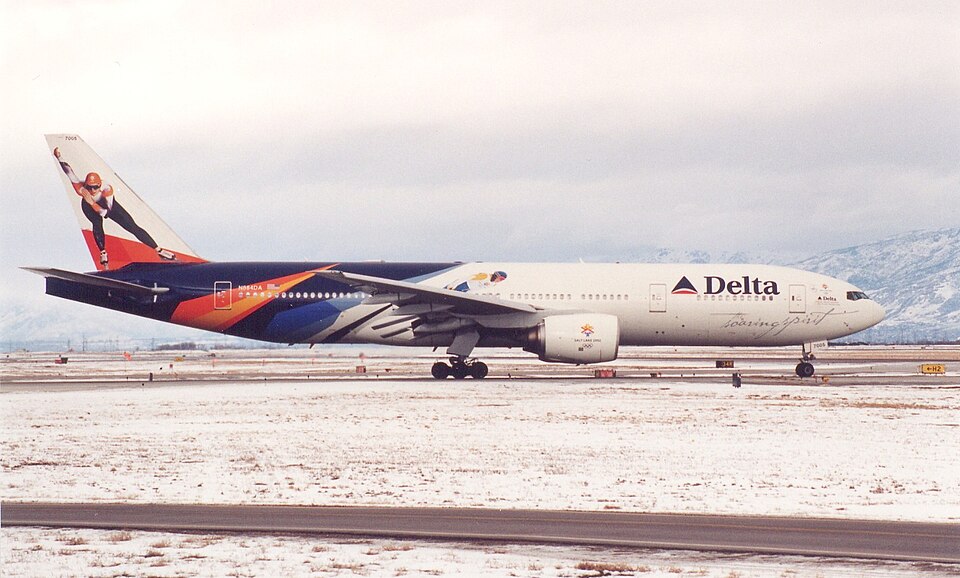
On 20 May 2005, a Boeing 777-232, registration N864DA, was involved in an accident at London Gatwick Airport. The aircraft, operated as a public transport passenger flight, collided with the passenger airbridge after overrunning the designated stopping point on Stand 50. The leading edge of the left engine intake cowl was damaged, and substantial damage was inflicted on the airbridge. No injuries were reported among the 13 crew and 296 passengers.
History of the Flight
The flight crew, consisting of a commander and two co-pilots, reported for duty at Atlanta Airport, Georgia, USA at 2120 hrs UTC on 19 May 2005. The aircraft departed Atlanta at 2322 hrs UTC and landed at Gatwick Airport at 0620 hrs UTC on 20 May 2005 after an uneventful flight. After landing, the commander took control from the handling co-pilot to taxi the aircraft. When clear of the runway, ATC instructed the crew to taxi to Stand 50. While taxiing, the crew shut down the left engine in accordance with company standard operating procedures.
As the aircraft approached the stand, both the commander and operating co-pilot confirmed visually that the stand was clear of obstructions. The commander turned the aircraft onto the stand using the Azimuth Guidance for Nose-In Stands (AGNIS) system. He alternated his gaze between AGNIS and the Parallax Aircraft Parking Aid (PAPA) board, identifying the Boeing 777-200 stopping mark. He stated that when the AGNIS system indicated the aircraft was no longer on the centreline, he became momentarily distracted while regaining alignment. When he looked again at the PAPA board, it indicated the aircraft was approaching the stopping point for a Boeing 777-300, and before he could stop, he felt a judder. He applied the brakes and saw the emergency STOP light flashing. After the ground engineer connected his headset, the crew learned that the left engine had struck the airbridge. The right engine was then shut down, and passengers disembarked using stairs on the right side.
Ground Staff Perspective
The ground crew, consisting of a team leader and five handlers, arrived at Stand 50 in good time. They checked the stand was clear and the airbridge was parked correctly. The team leader switched on the parking guidance system (AGNIS and PAPA). A ground crew member with chocks stood near the expected stopping point. When the aircraft continued past that point, he ran to the emergency STOP sign activation switch and turned it on, estimating he activated it just as the left engine contacted the airbridge. The dispatcher waiting in the control cabin at the end of the airbridge saw the aircraft moving past and felt the airbridge suddenly move; he initially thought it was malfunctioning until realizing it had been struck. Those on the airbridge ran back toward the terminal. No injuries occurred among ground staff, though some suffered slight shock.
Examination of the Aircraft and Stand
The aircraft stopped with nose wheels on the centreline, at a slight angle. The nose wheels were 7.3 m forward of the correct Boeing 777-200 parking position and 1.74 m forward of the Boeing 777-300 position. The airbridge had been parked correctly, with its wheel carriage inside the painted circle. The left engine struck the end of the airbridge at the point housing the rotating mechanism for the control cabin. The cabin was pushed off its left support roller, tilting approximately 10°. Sheared bolts, a broken drive chain, and damaged sidewalls were observed. The AGNIS and PAPA board indicator lights and the emergency STOP light were serviceable and correctly calibrated. It was noted that the PAPA board slot had no cover, allowing the glass terminal building and its vertical window supports to be seen through the slot, similar in appearance to the light tube.
Flight Recorders
The Flight Data Recorder (FDR) and Cockpit Voice Recorder (CVR) were removed and successfully replayed. FDR data showed that after turning onto the stand, the aircraft heading passed fractionally through the final heading (0.2°T), followed by a correction to the right (0.5°T) before recovering. Ground speed was between 4 and 5 kts and slowing. Heading stabilized 17 seconds after peak deviation, with ground speed reduced to approximately 2 kt. About 4 to 5 seconds later, disturbances in lateral and longitudinal acceleration and a drop in ground speed to zero were consistent with collision. Longitudinal deceleration peaked at approximately 0.05g; lateral acceleration peaked at less than 0.03g. Impact lasted 4 to 5 seconds; park brake was applied 7 to 11 seconds later. The CVR recorded the commander saying, “I never saw, I never saw it change. I missed it.” Cockpit conversation indicated initial unawareness of the seriousness of the impact; the commander requested a tug to push back to the stopping point.
Commander's Rest and Duty Time
The commander had a 24-hour rest period before the flight. He left his home in Texas at 1230 hrs UTC (0730 hrs local) to fly to Atlanta, arriving about 1700 hrs UTC. His flight duty time commenced at 2120 hrs UTC. During the flight to Gatwick (nearly seven hours), he rested for two and a quarter hours on a bunk. His arrival time at Gatwick (0620 hrs UTC) equated to 0120 hrs local time at his home.