Accident
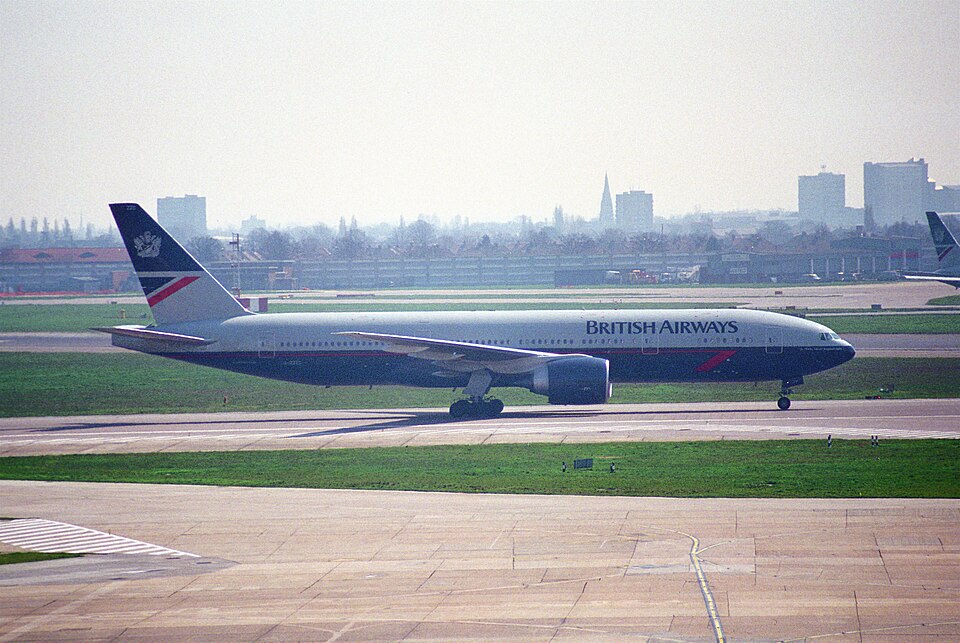
On 10 January 2006 at 0840 UTC, Boeing 777-236 G-ZZZC was being pushed back from Stand 422 at London Heathrow Airport's Terminal 4 when its left wing tip struck the right winglet of a parked Boeing 747-400 on Stand 423. The collision occurred during daylight with good visibility and dry apron surfaces.
Aircraft Information
G-ZZZC was a Boeing 777-236 manufactured in 1995, powered by two GE90-76B turbofan engines. The aircraft was operating a public transport passenger flight with 14 crew and 106 passengers on board. No injuries were reported among crew or passengers. The commander held an Airline Transport Pilot's Licence, was 39 years old, and had 8,600 total flying hours, including 3,600 on type.
Pushback Procedure
Stand 422 is situated at the head of the 'Victor cul-de-sac', necessitating a non-standard pushback onto the taxiway centreline. The adjacent Stand 423 was occupied by a company Boeing 747-400 correctly positioned. The standard pushback team for this stand required four members: a towbarless tractor (TBL) driver, a headset operator, and two wing/tail observers. However, due to staff shortages, only one observer was allocated. The modified procedure involved initially turning the aircraft tail to the right, then pushing back behind the Boeing 747-400, and finally turning the tail left as the aircraft was pushed onto the taxiway centreline.
At the time of the incident, ramp equipment including four container dolleys and one cargo container were parked at the edge of Stand 422. The TBL driver and headset operator discussed these and agreed they posed no hazard to the pushback. The wing observer arrived shortly before pushback and did not participate in that discussion.
Damage
G-ZZZC's left wing tip suffered damage to three static discharge wicks and the navigation light assembly. The Boeing 747-400's right winglet was punctured. Both aircraft were taken out of service for repairs.
Personnel
All three members of the pushback team were correctly trained and experienced in their tasks, including the TBL driver and wing observer who had received specific training for operations from Stand 422. The driver and observer were also trained in each other's roles. All were within company working hours limitations and fit for duty.
During pushback, the TBL driver initially oversteered the turn, potentially placing the aircraft on a collision course with the Boeing 747-400. The driver relied on the wing observer to signal if clearance was inadequate. As the pushback progressed, the wing observer found himself behind the cargo container, momentarily out of the driver's sight. While moving around the container, he continued to signal safe clearance but then quickly changed to a 'stop' signal and shouted. The driver stopped, but not before the wing tip struck the winglet.
Discussion
The operator's report indicated that the presence of the container and dolleys in the observer's path likely distracted him from his primary task of monitoring wing tip clearance at a critical time. They also may have prevented the driver from seeing the stop signal immediately. The observer arrived just before pushback without time to fully assess the obstacles. He could have signalled a temporary stop while repositioning, but did not.
Safety Actions
The aircraft operator made nine internal safety recommendations in response to the accident, all of which were accepted. These included providing visual guidance for drivers during the initial turn from Stand 422, ensuring minimum team numbers for pushback from certain stands, requiring staff to arrive with adequate time to plan and execute tasks, and ensuring ramp equipment is parked in designated safe areas, particularly at Stand 422.