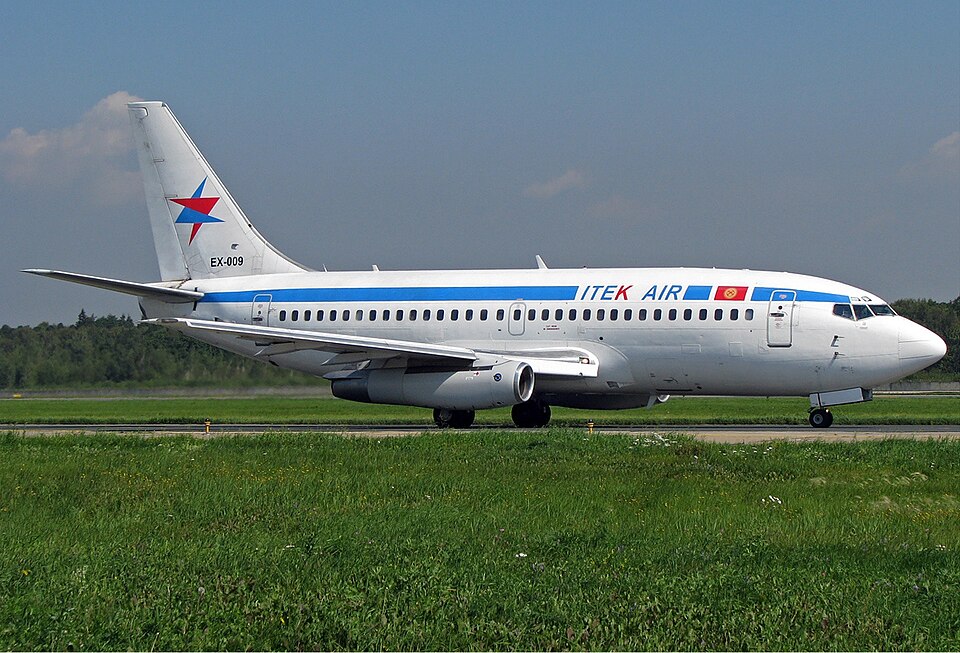
History of the Flight
On August 24, 2008, at 14:45 UTC, a Boeing 737-200 aircraft registered EX-009, operated by Itek Air, was conducting scheduled passenger flight IRC 6895 from Bishkek to Tehran. The crew comprised a pilot-in-command, a co-pilot, and three cabin crew members. There were 85 passengers on board, including two service passengers: a maintenance engineer and a representative of Iran Aseman Airlines. The flight was operated under a leasing agreement between Itek Air and Iran Aseman Airlines.
The crew passed a medical examination at the Manas Airport ground medical office without complaints. Preflight briefing was completed. Weather at departure, destination, and alternate aerodromes was favorable. Total fuel was 12,000 kg; takeoff weight was 48,371 kg with a center of gravity at 24.8% MAC, within limits.
After climbing to approximately 3,000 m, the crew informed ATC of a pressurization system fault and decided to return to Manas Aerodrome. While descending for a visual approach, the aircraft collided with the ground, was damaged on impact, and caught fire.
Injuries to Persons
The accident resulted in 64 passenger fatalities. Five crew members and 21 passengers sustained serious injuries. One passenger initially injured later died of burn disease complicated by pneumonia on October 23, 2008, after being transferred to a burn resuscitation department.
Damage to Aircraft
The aircraft was totally destroyed and burnt. No other objects were damaged.
Personnel Information
The pilot-in-command, born January 10, 1951, held a Class I ATPL license issued by the Department for Civil Aviation of Kyrgyz Republic on July 3, 2000, valid until November 20, 2008. He had total flying experience of 18,250 hours, including 11,237 hours as captain and 2,337 hours on the Boeing 737-200. His last checkride was on February 21, 2008, and his most recent simulator training was on August 20, 2008, at Sabena Flight Academy in Brussels. He had 25 hours of rest before the accident flight.
Flight Recorders and Data
The aircraft was equipped with a flight data recorder (980-4100 GQUS) and a cockpit voice recorder. ATC recorder and radar data were also available. The investigation synchronized these recordings to reconstruct the flight trajectory.
Wreckage and Impact Information
The aircraft struck the ground 9.7 km from the Manas Aerodrome Reference Point on a bearing of 273° magnetic. The wreckage and impact information were analyzed as part of the investigation.
Medical and Pathological Information
Medical and pathological examinations were conducted as relevant to the investigation.
Survival Aspects and Fire
Survival aspects were examined. Fire and rescue operations were performed at the scene.
Organizational and Management Information
The investigation considered organizational and management aspects of the operator and oversight authorities.
Additional Information
Additional topics included visual approaches and regulations of altimeter settings.
Probable Cause
No probable cause was stated in the provided report excerpt.