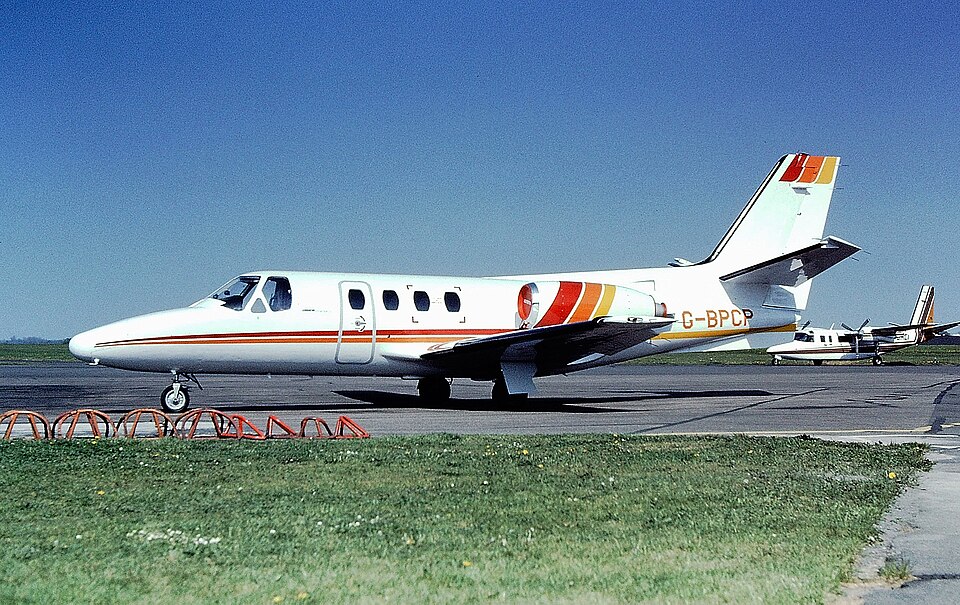
On October 1, 1980, a Cessna 500 Citation (registration G-BPCP) operated by Penarth Commercial Properties was involved in an aviation accident near Jersey, United Kingdom during landing or approach. One person was killed. Investigators recorded the probable cause as: The accident was caused by the commander failing to execute correctly a missed approach 'go-around' manoeuvre in conditions of poor visibility and low cloud at night. This summary draws on records from the Bureau of Aircraft Accidents Archives (B3A).
A pilot was killed when G-BPCP struck a house 190 m north of the Jersey runway threshold during a night approach in poor visibility and low cloud. Four house occupants escaped with injuries.
Flight Background and Weather Planning The pilot had completed three flights earlier that day. He departed Jersey at 0729 hrs for Coventry via Cardiff for business meetings in the Midlands, with an evening return planned via Cardiff. Before leaving Coventry at 1729 hrs, he filed ATC flight plans for the sectors to Cardiff and Jersey and checked Jersey weather. The forecast indicated poor conditions with low cloud and visibility intermittently falling to 400 metres in drizzle, with 7 oktas of cloud below 100 feet. A 1650 hrs weather report noted on his flight plan showed surface wind 2900 at 11 knots, visibility 6000 metres, 4 oktas of cloud at 100 feet and 7 oktas at 200 feet, intermittently becoming 3000 metres visibility in drizzle with 6 oktas of cloud at 100 feet. Sufficient fuel for a return from Jersey was loaded at Cardiff, and the pilot told a Customs Officer he might have to return because of the weather at Jersey. ## Departure from Cardiff and En Route Information The aircraft departed Cardiff for Jersey at 1821 hrs. It could not be established whether the pilot obtained the latest Jersey weather reports issued at 1720 hrs and 1750 hrs while at Cardiff, or used the in-flight weather broadcast service by London Volmet South, which transmitted the 1820 hrs Jersey weather report en route. Had he done so, he would have known that landing conditions were deteriorating: the 1820 hrs report showed visibility 300 metres, runway visual range (RVR) 800 metres in drizzle, and 8 oktas of cloud below 200 feet. ## Approach to Jersey By 1842 hrs the aircraft was descending toward Jersey. The pilot was in radio contact with Jersey Zone ATC, had received inbound clearance, and had been advised of the latest Jersey weather. Radar guidance was provided by Jersey Zone and later by Jersey Approach Control, which advised that RVR had fallen to 850 metres and later to 650 metres. On receiving this information, the pilot asked for Guernsey weather. He was told Guernsey visibility had improved to 1800 metres, although the cloud base remained below 100 feet. At 1857 hrs, when seven miles from the approach to runway 27 at Jersey, the pilot reported being established on the Instrument Landing System (ILS). He then contacted Jersey Tower, which cleared G-BPCP to land. ## Final Approach and Impact During the final stages of the approach, about 45 seconds before the crash, the Tower controller advised that RVR had improved to 850 metres. This message was not acknowledged. The approach controller continued to observe the aircraft on radar until it was about one mile from the threshold, where it appeared to be on the extended centre line of the runway. The controller then left the radar screen and went to a window to watch for the landing. When the aircraft was half a mile from the runway, an eyewitness observed it on a normal approach path for runway 27. It was lost to view as it passed behind an adjacent house, and almost immediately there was an increase in engine power. A professional pilot on the aerodrome, about 500 metres from the end of the runway, heard the engines “start to spool-up as for an overshoot” and shortly afterwards saw a flash and heard an explosion. The aircraft struck the roof of a house located 190 metres north of the runway threshold centre line. The house caught fire; the tail lodged in the blazing roof while the remaining structure fell into a courtyard and was destroyed by fire. Four people in the house escaped with minor injuries, although one young girl was detained in hospital with serious burns. The pilot was killed.
Probable cause
The accident was caused by the commander failing to execute correctly a missed approach 'go-around' manoeuvre in conditions of poor visibility and low cloud at night. He failed to fly an accurate procedure and allowed the aircraft to continue to descend and turn to the right. It is probable that this resulted from incorrect instrument flying technique, but partial physical incapacitation cannot be ruled out. It is also probable that spatial disorientation was a causal factor.