Background
The aircraft was managed by Jackson Air Charter, Inc. (JAC), a Part 135 on-demand operator, but was being used for the owner's personal purposes, so the flight was conducted under 14 CFR Part 91. The right-seat pilot, who was JAC's chief pilot and served as the flying pilot, had approximately 13,312 total flight hours, including 833 hours in Cessna 560 airplanes. The left-seat pilot, the nonflying pilot, had about 11,607 total flight hours, with 557 hours in Cessna 560 airplanes. He had been employed by JAC for just over a month and had not yet completed the company's Part 135 training.
Flight Details
The flight was planned to land at Rochester International Airport (RST) in Minnesota. The crew attempted to circumnavigate severe weather and continued their descent for about 15 minutes, despite being told by Minneapolis Air Route Traffic Control that deviations of 100 miles north or 80 miles south would be necessary. The RST approach controller also reported wind gusts and weather on the final approach, and onboard radar confirmed severe thunderstorms in the area. Despite this, the crew chose to continue toward RST.
About 3 minutes after contacting RST approach, the crew began discussing an alternate airport. However, neither pilot took a leadership role in the decision, and the left-seat pilot did not adequately communicate the diversion to air traffic control. The crew selected Ellen Church Field Airport (CJJ) in Cresco, Iowa, based on a map or visual sighting, without being familiar with the airport. CJJ had no weather reporting, and the crew did not use onboard resources such as the flight management system or charts to determine runway direction or length.
Approach and Landing
During the approach, the Enhanced Ground Proximity Warning System (EGPWS) activated because it did not recognize the runway, which was less than 3,500 feet long. The crew attributed the alert to descent rate rather than recognizing the true cause. They also noted that the runway was not depicted on a non-navigational publication that listed runways 3,000 feet or longer. During final approach, they visually realized the runway was shorter than the at least 5,000 feet they had earlier believed. Despite all indications of insufficient length, they continued the landing.
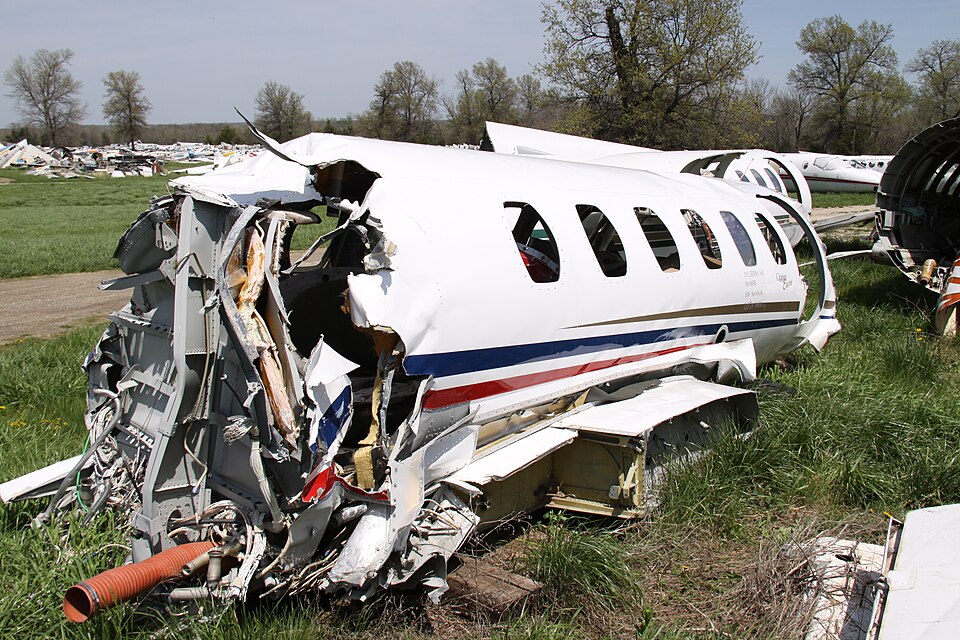
Cessna later calculated that under the accident conditions—wet runway and 10-knot tailwind—about 5,200 feet would have been needed to stop. Runway 33 at CJJ is only 2,949 feet long. The aircraft exited the runway end and traveled about 1,700 feet beyond. The aircraft had sufficient fuel to reach an airport with a suitable runway.
Crew Resource Management and Decision-Making
The investigation found that the crew exhibited poor aeronautical decision-making and inadequate crew resource management (CRM). They failed to use available onboard and airport resources, did not effectively communicate, and neither pilot assumed a leadership role. JAC did not have a required CRM training program for Part 135 operations, though some CRM was included in simulator training. The National Transportation Safety Board had previously issued Safety Recommendation A-03-52 to require CRM training for Part 135 operators, reiterating it after this accident.
Toxicology testing revealed the right-seat pilot had recently used a prescription muscle relaxant, which could have caused impairment, but the role of the medication or his physical symptoms could not be determined.
Probable Cause
The National Transportation Safety Board determined the probable cause to be the flight crew's inadequate aeronautical decision-making and poor crew resource management, including the inadequate use of onboard sources such as the flight management system and navigation charts, to obtain critical information about Ellen Church Field Airport, including runway direction and length. Contributing factors were the flight crew's failure to consider and understand indications that the runway length was insufficient and inadequate CRM training for pilots at Part 135 on-demand operators.