Accident
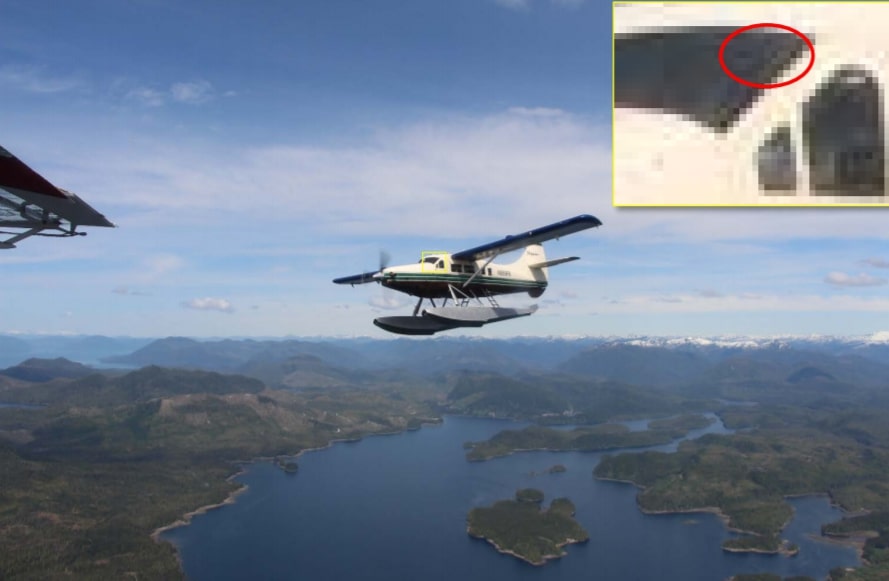
On May 13, 2019, about 1221 Alaska daylight time, a float-equipped de Havilland DHC-2 (Beaver) airplane, registration N952DB, and a float-equipped de Havilland DHC-3 (Otter) airplane, registration N959PA, collided in midair about 8 miles northeast of Ketchikan, Alaska. The collision occurred over the Mahoney Lakes area on Revillagigedo Island. Visual meteorological conditions prevailed at the time.
Aircraft and Operators
The DHC-2 was registered to and operated by Mountain Air Service LLC of Ketchikan, Alaska, under 14 CFR Part 135 as an on-demand sightseeing flight. The DHC-3 was registered to Pantechnicon Aviation LTD of Minden, Nevada, and operated by Venture Travel, LLC, doing business as Taquan Air, of Ketchikan, Alaska, also under Part 135. Both aircraft were on sightseeing flights to the Misty Fjords National Monument area and were converging on a scenic waterfall before returning to the Ketchikan Harbor Seaplane Base.
Sequence of Events
According to recorded avionics data from the DHC-3, it departed Rudyerd Bay about 1203 and flew westward toward Point Eva and Manzanita Island. At 1209, at an altitude between 1,900 and 2,200 ft, it crossed Behm Canal then turned southwest near Lake Grace around 1212. ADS-B tracking data began at 1213:08 for the DHC-3 and 1213:55 for the DHC-2. At 1217:15, the DHC-3 was level at 4,000 ft msl over Carroll Inlet on a track of 225°, while the DHC-2 was 4.2 nm south, climbing through 2,800 ft on a track of 255°. The DHC-3 pilot stated he checked his traffic display and saw two groups of blue triangles to his left but did not observe the DHC-2 before the collision. Around 1219, the DHC-3 began descending from 4,000 ft, and the DHC-2 climbed from 3,175 ft. Over the next 1 minute 21 seconds, the DHC-3 descended on tracks between 224° and 237°, while the DHC-2 leveled at 3,350 ft on a track of about 255°. Between 1220:21 and 1221:14, the DHC-3 made a shallow left turn to 210°, then a shallow right turn back to 226°. The collision occurred at 1221:14 at an altitude of 3,350 ft, 7.4 nm northeast of the base. ADS-B data ended near the collision time. The DHC-2 broke into multiple pieces and impacted water and terrain northeast of Mahoney Lake. The DHC-3 experienced a brief vertical load factor upset, then entered a right bank reaching 50° right wing down at 1221:19 and 27° nose down at 1221:22. It descended, completed a 180° turn, and impacted George Inlet at 1222:15 on a northeast track.
Injuries and Damage
The DHC-2 pilot and four passengers sustained fatal injuries, and the DHC-2 was destroyed. The DHC-3 pilot sustained minor injuries, nine passengers sustained serious injuries, one passenger sustained fatal injuries, and the DHC-3 sustained substantial damage.
Probable Cause
The NTSB determines that the probable cause of this accident was the inherent limitations of the see-and-avoid concept, which prevented the two pilots from seeing the other airplane before the collision, and the absence of visual and aural alerts from both airplanes’ traffic display systems, while operating in a geographic area with a high concentration of air tour activity. Contributing to the accident were 1) the Federal Aviation Administration’s provision of new transceivers that lacked alerting capability to Capstone Program operators without adequately mitigating the increased risk associated with the consequent loss of the previously available alerting capability and 2) the absence of a requirement for airborne traffic advisory systems with aural alerting among operators who carry passengers for hire.