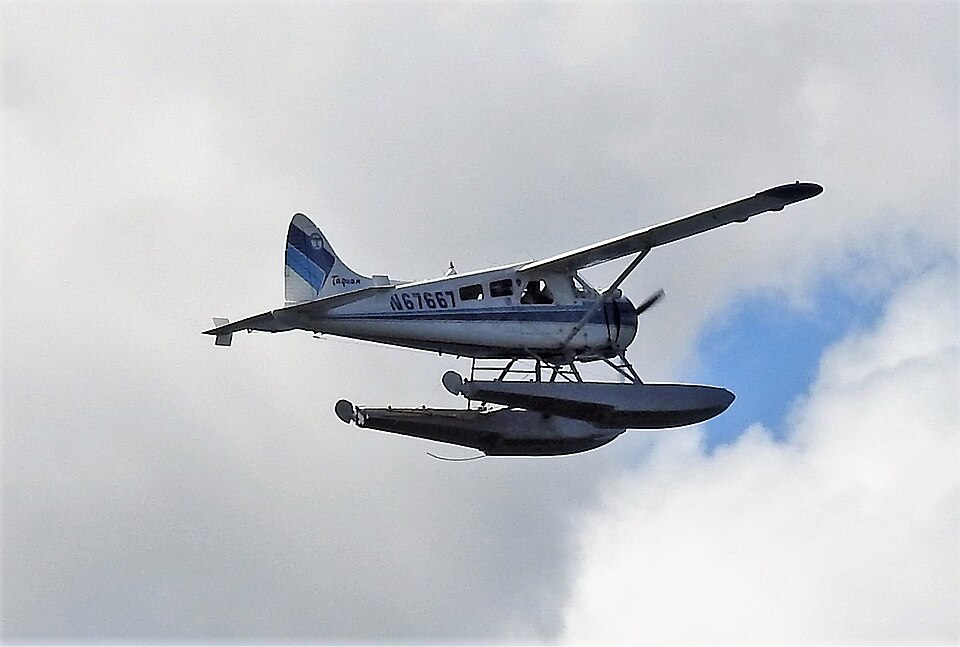
Accident Overview
A commercial pilot was conducting his first scheduled commuter flight from the company’s seaplane base to a nearby island seaplane base, carrying one passenger and cargo. According to company pilots, the destination harbor was known for challenging downdrafts and changing wind conditions due to surrounding terrain.
Witness Observations
Multiple witnesses at the destination observed the airplane making a westerly approach, with the wind from the southeast and light chop on the water. Two witnesses reported the wings rocking left and right before touchdown. One witness stated that a wind gust pushed the tail up before the airplane landed. Another witness noted that the airplane was drifting right during touchdown. A different witness saw the right (downwind) float submerge after touchdown, followed by the airplane nosing over as it pivoted around the right wingtip, which impacted the water.
Flight Track and Performance Data
Flight track and performance data from the cockpit display units revealed that, as the airplane descended on final approach, the wind changed from a right headwind of 6 knots to a left quartering tailwind of 8 knots before touchdown. The crosswind and tailwind components were within the airplane’s operational limitations.
Mechanical Examination
Examination of the airframe, engine, and associated systems showed no evidence of mechanical malfunctions or failures that would have precluded normal operation or egress.
Pilot Information and Company Practices
During the final approach, the pilot had various wind information available, including sea surface wind waves, nearest airport observation winds, cockpit display calculated wind, and visual relative ground speed. The pilot was hired the previous month with 5 hours of seaplane experience and completed company-required training and competency checks less than 2 weeks before the accident. According to the chief pilot (CP), company policy was to assign newly hired pilots to tour flights to gain experience before assigning them to commuter flights later in the season. The previous year, the CP distributed a list of each pilot’s clearances for specific flights and destinations; however, an updated list had not been generated for the season at the time of the accident. The flight coordinators, who delegated operational control for assigning pilots to flights, and the station manager were unaware of the pilot’s assignment limitations.
Risk Assessment
Before the flight, the flight coordinator on duty completed a company flight risk assessment that assigned numerical values based on flight experience levels. The total risk value for the flight fell in the caution area, which required management notification before releasing the flight, due to the pilot’s lack of experience in the accident airplane make and model and with the company, and his unfamiliarity with the geographical area. However, the flight coordinator did not notify management before release because the CP had approved a tour flight with the same risk value earlier that day. Had the CP been notified, he may not have approved the pilot’s assignment to the accident flight.
Outcome
The pilot's minimal operational experience in seaplane operations likely affected his situational awareness in rapidly changing wind conditions and his ability to compensate adequately for a quartering tailwind at a higher-than-normal ground speed, which resulted in a loss of control during the water landing and a subsequent nose-over.