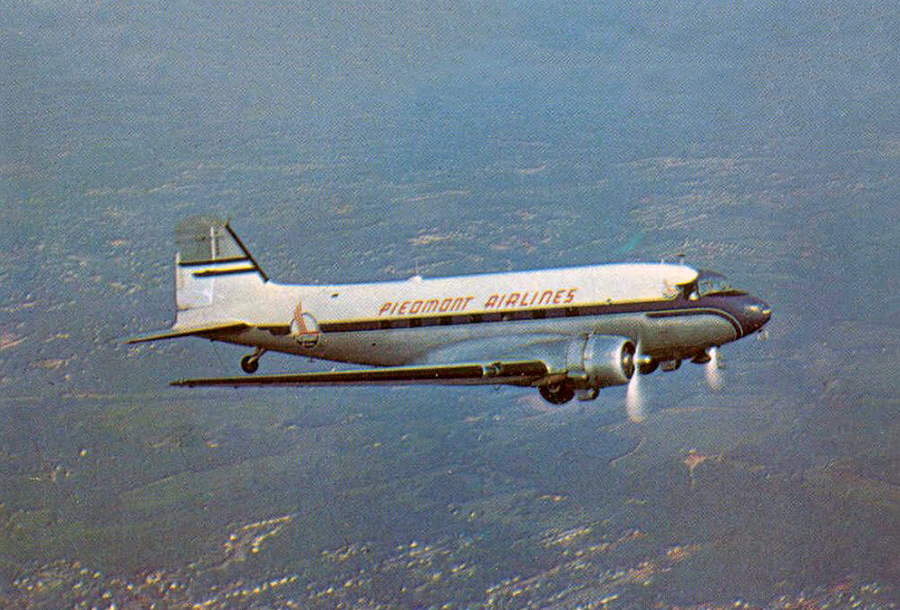
Accident
About 2040 on October 30, 1959, Piedmont Airlines Flight 349 crashed on Bucks Elbow Mountain, approximately 13 miles west of the Charlottesville-Albemarle County Airport in Virginia. The aircraft, a Douglas DC-3 registered as N55V, was demolished by impact. The crew of three and 23 of the 24 passengers were killed; the sole survivor was seriously injured.
The accident occurred during an intended instrument approach. Specifically, it happened during the inbound portion of the procedure turn, which was being flown 6 to 11 miles west of the maneuvering area prescribed by the instrument approach procedure.
Investigation
According to the Civil Aeronautics Board investigation, the lateral error resulted from a navigational omission. The pilot did not turn left about 20 degrees to conform to V-140 airway at the Casanova omni range station. Consequently, when the pilots believed the flight was over the Rochelle intersection, it was actually 13 miles northwest of track position. When the pilot turned left and flew the heading normally flown from Rochelle intersection, the aircraft's ground path was displaced 8 to 11 miles west of the prescribed track.
The Board concluded that the error went undetected because tracking and other instrument approach requirements were not followed precisely. Based on information about the captain's personal background and expert medical analysis, the Board opined that preoccupation resulting from mental stress may have been a contributing factor.
Probable Cause
The Board determined that the probable cause of this accident was a navigational omission which resulted in a lateral course error that was not detected and corrected through precision instrument flying procedures. A contributing factor to the accident may have been preoccupation of the captain resulting from mental stress.