Accident Overview
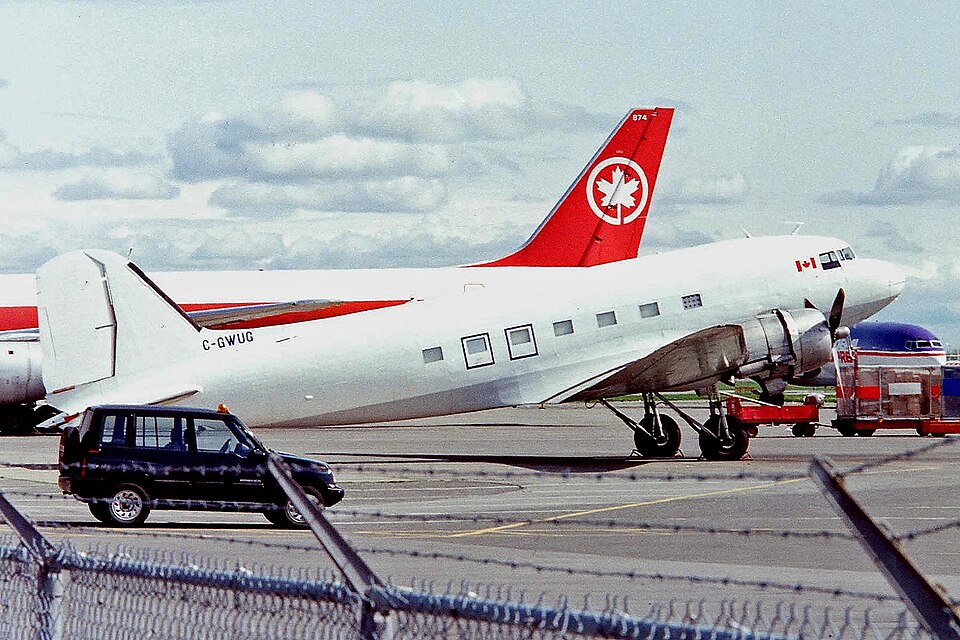
The accident aircraft, a Douglas DC-3C registered C-GWUG, was owned and operated by Kelowna Flightcraft Air Charter Ltd. (Kelowna Flightcraft) and under charter to Purolator Courier Ltd. (Purolator). Since April 1998, the aircraft had been dedicated to transporting cargo between Vancouver and Nanaimo, British Columbia, with occasional flights to Victoria. On the day of the accident, operating as KFA300, the aircraft was rerouted to fly from Vancouver to Victoria and then to Nanaimo after the delayed arrival of Purolator's Boeing 727 due to inclement weather in the Toronto/Hamilton area. The crew received a pre-flight planning package including filed IFR flight plans for both legs.
Flight Sequence
The captain cancelled the IFR flight plan and refiled as VFR on first contact with air traffic control. Vancouver tower cleared KFA300 for take-off at 0622 Pacific standard time from runway 26L. After departure, the aircraft turned left toward Active Pass. The captain requested an altitude of 1000 feet above sea level (asl), which was approved. Radar data showed the aircraft climbed to and leveled at 1000 feet asl, accelerating to a steady ground speed of 130 knots. The aircraft left the Vancouver control zone at 0626 and entered Class E controlled airspace, where no special VFR requirements or specific ATC services apply.
As the aircraft approached the Gulf Islands, it descended slightly and remained level at 900 feet asl. It crossed about 0.25 nautical mile west of the Active Pass non-directional beacon at 0632, maintaining 130 knots ground speed and 900 feet asl. At 0633:04, the aircraft descended to 800 feet asl for about nine seconds. The last radar data show the aircraft at 900 feet asl and 130 knots, with the final radar position on a bearing of 189 degrees true, 21.8 nautical miles from the Sea Island radar source, coincident with the crash location.
Official Findings
The investigation identified the following causes and contributing factors: 1. The accident flight was not conducted in accordance with the night obstacle clearance requirements of Canadian Aviation Regulation (CAR) 705.32. 2. The Kelowna Flightcraft company operations manual did not reflect the restrictive conditions imposed on night VFR flight by CAR 705.32, which might have prevented the accident by ensuring crew awareness of night obstacle clearance standards. 3. As the aircraft approached Mayne Island, it encountered a low cloud ceiling based about 800 feet that reduced visual reference with the surface. 4. When the aircraft struck trees, it was being flown in controlled, level flight at an altitude below the surrounding terrain. 5. The aircraft was not equipped with a ground proximity warning system or any similar system that could warn of impending terrain collision; such systems were not required by regulation.
Findings as to risk included that Kelowna Flightcraft flight operations personnel were not aware that most DC-3 flights were conducted under VFR, and first responders were not aware of the presence of dangerous goods, increasing their risk during response activities. Other findings noted that Transport Canada officials responsible for monitoring this operation were not aware that most DC-3 flights were conducted under VFR at night and below required obstacle clearance altitudes.