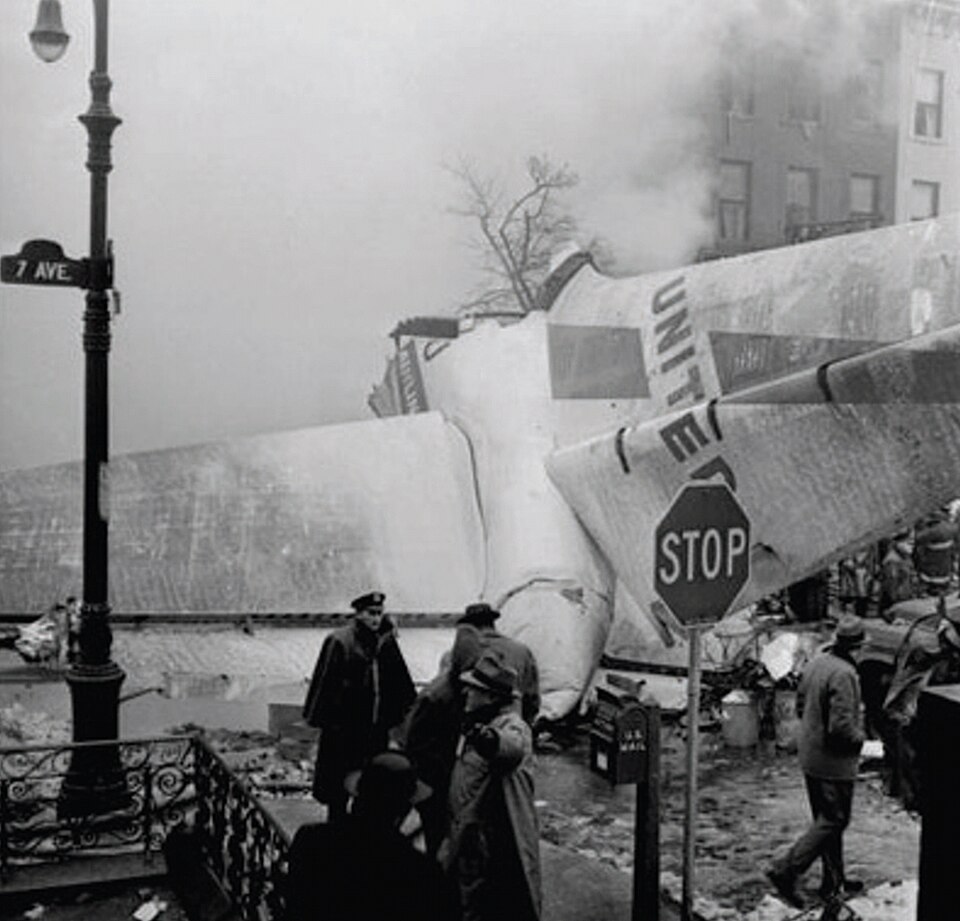
On December 16, 1960, a Douglas DC-8 (registration N8013U) operated by United Airlines was involved in an aviation accident near New York, United States of America during landing or approach. 90 people were killed. Investigators recorded the probable cause as: The Board determines that the probable cause of this accident was that United Flight 826 proceeded beyond its clearance limit and the confines of the airspace allocated to the flight by Air Traffic Control. This summary draws on records from the Bureau of Aircraft Accidents Archives (B3A); 4 related events involving the same aircraft type or operator are linked below.
On Dec. 16, 1960, a TWA Constellation and a United DC-8 collided near Staten Island, killing all 128 aboard and 6 on the ground. The DC-8 had passed its clearance limit.
Accident Overview and Losses On December 16, 1960, at 1033 e.s.t., a midair collision occurred near Miller Army Air Field, Staten Island, New York, involving Trans World Airlines Flight 266, a Model 1049A Constellation registered N 6907C, and United Air Lines Flight 826, a DC-8 registered N 8013U. Both aircraft were operating under Instrument Flight Rules. The Constellation fell on Miller Army Field, while the DC-8 continued northeast and crashed into Sterling Place near Seventh Avenue in Brooklyn. Both aircraft were totally destroyed. All 128 occupants of the two aircraft and 6 persons on the ground in Brooklyn were fatally injured, and considerable property damage occurred in the area of the DC-8 ground impact. ## Flight Operations and Navigation TWA Flight 266 originated at Dayton, Ohio, with a destination of LaGuardia Airport, New York, and one en route stop at Columbus, Ohio. It departed Port Columbus Airport at 0900 and was vectored by LaGuardia Approach Control to the final approach course for runway 4. The flight was cleared to descend to 5,000 feet and was twice advised of traffic in the vicinity on a northeasterly heading. After this information was transmitted, the radar targets appeared to merge on the LaGuardia Approach Control radar scope, and communications with TWA 266 were lost. United Air Lines Flight 826 was a non-stop service from O'Hare Airport, Chicago, Illinois, to New York International Airport, New York. It contacted the New York Air Route Traffic Control Center at 1012 and was cleared to proceed from the Allentown, Pennsylvania, VOR direct to the Robbinsville, New Jersey, VOR, and then to the Preston Intersection via Victor Airway 123. At approximately 1021, the crew advised ARINC that the No. 2 receiver accessory unit was inoperative, indicating that one of the aircraft's two VHF radio navigational receivers was not functioning. Air Traffic Control was not advised of this malfunction. ## Contributing Circumstances At 1025, the New York ARTCC issued a clearance for a new routing that shortened the distance to Preston by approximately 11 miles. This reduced the time available for the crew to retune the single radio receiver to either the Colt's Neck, New Jersey, or Solberg, New Jersey, VOR to establish the cross-bearing with Victor 123 and identify the Preston Intersection. Alternatively, crossbearings on the Scotland Low Frequency Radiobeacon could have been taken with the aircraft's direction finding equipment, but this would have required rapid mental calculation and interpretation of a display that could be easily misread. UAL 826 was not receiving radar vectors and was providing its own navigation. After the flight reported passing through 6,000 feet, the New York Center advised that radar service was terminated and instructed the flight to contact Idlewild Approach Control. UAL 826 then called Idlewild Approach Control, stating, “United 826 approaching Preston at 5,000.” This was the last known transmission from UAL 826. At the time of this transmission, the aircraft had in fact gone past the Preston clearance limit several seconds earlier and was several miles past the point at which it should have turned into the holding pattern. This is confirmed by data from the flight recorder installed in the UAL DC-8 and by analysis of the communication tapes. ## Collision and Weather A collision occurred at a point approximately 11 miles past the Preston Intersection. Weather at the altitude of the collision and at the time of the accident was such as to preclude flight by visual means.
Probable cause
The Board determines that the probable cause of this accident was that United Flight 826 proceeded beyond its clearance limit and the confines of the airspace allocated to the flight by Air Traffic Control. A contributing factor was the high rate of speed of the United DC-8 as it approached the Preston intersection, coupled with the change of clearance which reduced the enroute distance along VICTOR 123 by approximately 11 miles.