History of Flight
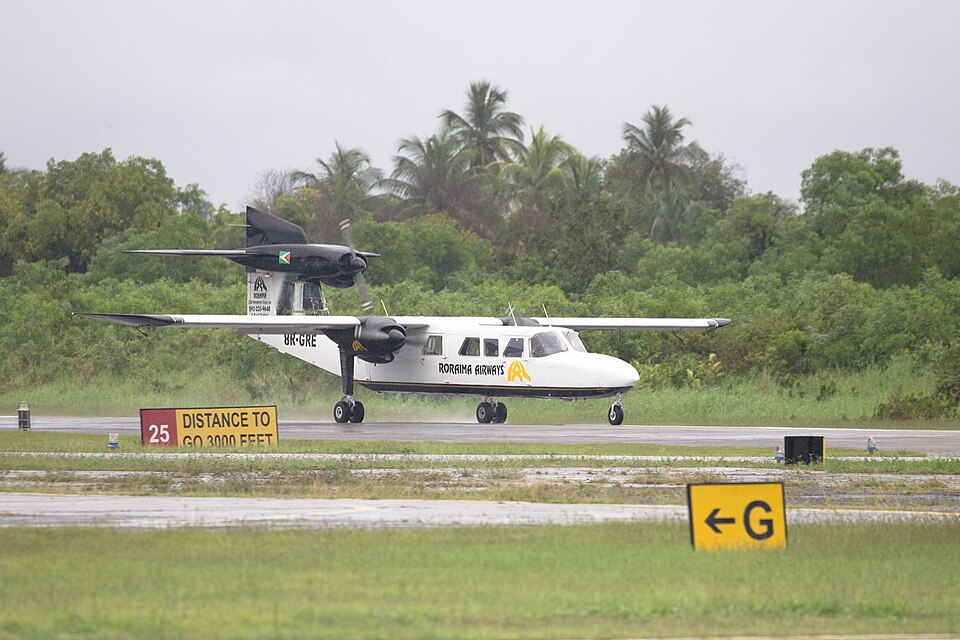
On 14 August 2021, a Britten-Norman BN-2A-III-2 Trislander, registered as 8R-GRE and operated by Roraima Airways Inc., departed Imbaimadai Aerodrome (SYIB) at approximately 14:20 UTC (10:20 GST) on a scheduled commercial passenger and cargo flight to Eugene F. Correia International Airport (SYEC). The aircraft carried two crew members (a Commander and an Observer Pilot), three passengers, and about 281 pounds of cargo. Approximately seven nautical miles from the destination, the tail (rear) engine lost power and became inoperative. The Commander secured the engine and activated the fuel transfer pumps. Shortly after, the port engine lost power, briefly regained it, then failed again, followed immediately by the starboard engine. The aircraft experienced total loss of propulsive force from all three engines.
Unable to reach the intended airport, the Commander decided to force-land the aircraft. The aircraft descended into a swampy area of the Haags Bosch Sanitary Landfill in Region 4, Guyana. The presence of tall grass and approximately three feet of standing water may have cushioned the impact. The aircraft sustained structural damage mainly to the nose section and the nose landing gear.
Injuries and Damage
After landing, the Commander attended to a female adult passenger who had a gash over her left eye and was in distress. A male adult passenger was later diagnosed at a hospital with a bleeding liver. The Observer Pilot, the Commander, and a child under two years old were uninjured. The aircraft's nose section and landing gear were damaged.
Fuel Examination
Investigators from the Guyana Aircraft Accident & Incident Investigation Unit (GAAIIU) and the Guyana Civil Aviation Authority (GCAA) later examined the fuel tanks. The starboard main tank contained 25 imperial gallons, the starboard tip tank 3 imperial gallons, the port main tank 8 imperial gallons, and the port tip tank 11 imperial gallons. Note that on the Trislander, fuel from the tip tanks cannot be fed directly to the engines; only the main tanks supply the engines. Fuel must be transferred from the tip tanks to the main tanks if the main tanks are insufficient. Fuel flow checks conducted on all three engines according to the approved maintenance manual were found satisfactory.
Probable Cause
The investigation determined that the accident occurred due to total engine failures resulting from fuel starvation, combined with the pilot's decision to land in the landfill. The fuel starvation was caused by depletion of fuel in the main tanks. The Commander did not verify before departure that the main tanks contained sufficient fuel for the flight, nor did he transfer fuel from the tip tanks (which still contained fuel) to the main tanks to sustain the flight schedule.