Summary
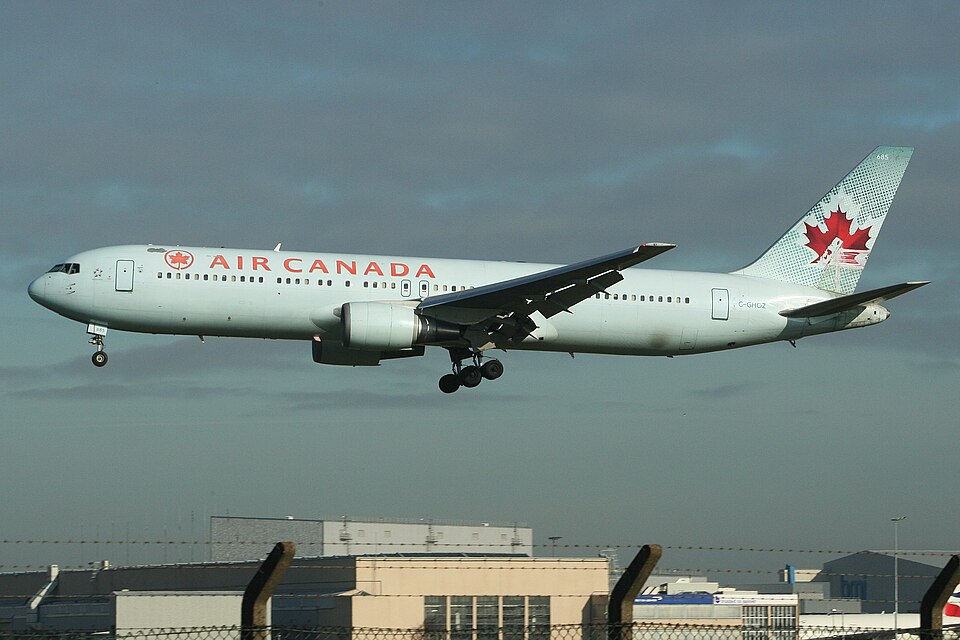
On Monday, 3 February 2020, a Boeing 767-375ER aircraft, registration C-GHOZ, operated by Air Canada as flight ACA837, was departing from Madrid-Adolfo Suárez Airport (Spain) en route to Toronto Pearson Airport (Canada). At 14:58 local time, two seconds before lift-off, the number 5 tire on the left main landing gear failed due to a puncture from a sharp foreign object (FOD) on runway 36L. The tire burst and its tread separated; several fragments were ingested by the left engine (engine number 1), causing internal damage. The crew continued the take-off, shut down the left engine, and declared an emergency at an altitude of approximately 700 feet above ground level while still on the runway heading.
Flight History
After declaring the emergency, the aircraft was directed by air traffic control to fly to the southeast of the airport. To reduce landing weight, the crew executed holding patterns at 5,000 feet and later at 8,000 feet to consume fuel. During this holding period, a military aircraft from the Torrejón de Ardoz Air Force base was dispatched to visually inspect the landing gear damage from outside. By 18:56, sufficient fuel had been burned, and the aircraft began its approach to runway 32L at Madrid-Adolfo Suárez Airport. The aircraft landed without incident at 19:08 and came to a stop on the runway. Ground crews used fans to reduce the temperature of the landing gear brakes. The aircraft exited the runway under its own power at 19:55, and passengers disembarked normally at 20:11.
Injuries and Damage
No injuries were reported among the 138 people on board—two pilots, six cabin crew, and 130 passengers. The aircraft sustained damage to the left main landing gear tire and the left engine from ingested debris. The runway was also affected, with debris scattered along the takeoff path.
Investigation Findings
The investigation conducted by Spain's Civil Aviation Accident and Incident Investigation Commission (CIAIAC) determined that the incident was caused by the presence of a sharp foreign object (FOD) on runway 36L at Madrid-Adolfo Suárez Airport. This object punctured tire number 5 on the left main landing gear, leading to the tire explosion and subsequent secondary failures. The report included four safety recommendations: three directed to ENAIRE, the air navigation service provider, and one to AENA, the runway and apron inspection service provider at the airport.
Key Facts
- Operator: Air Canada
- Aircraft: Boeing 767-375ER, registration C-GHOZ
- Date: 3 February 2020
- Location: Madrid-Adolfo Suárez Airport (LEMD)
- Phase of flight: Take-off
- Occupants: 138 (8 crew, 130 passengers), all uninjured
- Cause: Sharp foreign object on runway 36L