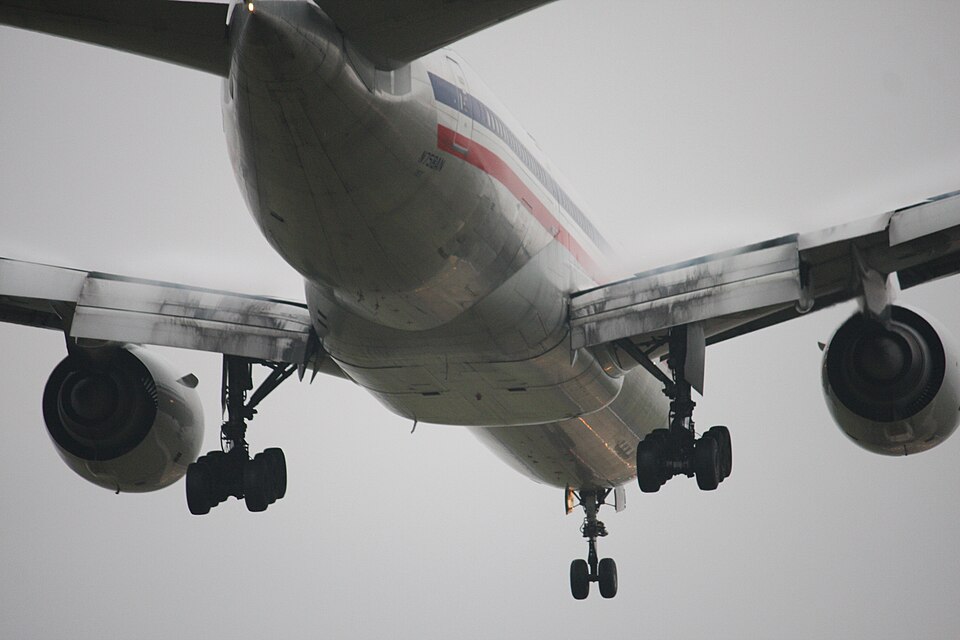
Mid-taxi collision between Iberia A330 and American Airlines B777 at Madrid-Barajas

Casualties unknown • Aeropuerto de Madrid-Barajas (Madrid), ES

An Airbus A330-300 and a Boeing 777-200 collided during taxi operations at Adolfo Suárez Madrid-Barajas Airport, resulting in structural damage to both aircraft.

What happened

On 6 December 2015, an Iberia Airbus A330-300, registration EC-LZX, was taxiing at Adolfo Suárez Madrid-Barajas Airport following a flight from Miami. The aircraft was instructed to follow route B to gate 12. Simultaneously, an American Airlines Boeing B-777-200, registration N758AN, was stopped on taxiway Z1, awaiting clearance to enter runway 36L.

As the Iberia crew approached the intersection of taxiways B2, B3, and Z1, they observed that the American Airlines aircraft was positioned very close to their path. Despite recognizing the limited clearance, the crew decided to continue taxiing behind the stationary aircraft. During the maneuver, the left wing of the A330-300 struck the right elevator of the B-777-200, causing a crack on the lower surface. As the aircraft continued its path, the left winglet of the A330-300 subsequently impacted the right wingtip of the B-777-200.

The investigation

The CIAIAC investigation examined the geometric configuration of the taxiway markings, the aeronautical documentation used by the crews, and the cockpit voice recordings. The investigation looked into the positioning of the American Airlines aircraft relative to the runway 36L holding point and the instructions provided by air traffic control.

Investigators analyzed the responsibilities of the flight crews and the controllers, specifically noting the captain's decision-making process regarding fuel-saving policies and the physical limitations of visibility from the cockpit. The study also reviewed the accuracy of Jeppesen aeronautical charts used by the pilots during the ground movement.

Findings

  • The primary cause of the incident was the decision of the crew of aircraft EC-LZX to continue taxiing behind aircraft N758AN despite being aware that the space was extremely limited.
  • The American Airlines aircraft, N758AN, had stopped 40 meters before the runway 36L holding point marking, which resulted in the aircraft encroaching on the strip of taxiway B.
  • The air traffic controller did not instruct the crew of the American Airlines aircraft to move forward to a safer position, nor did they warn the Iberia crew of the obstruction.
  • The Jeppesen aeronautical charts used by the crews omitted a critical instruction found in the AIP-Spain, which states that aircraft should taxi as close as possible to runway and intermediate holding points.
  • The Iberia captain attempted to maneuver around the obstacle to avoid a full stop, as stopping would have required significant thrust, impacting fuel efficiency and increasing noise.

Probable cause

The collision was caused by the Iberia crew's decision to proceed behind a stationary aircraft despite insufficient clearance, compounded by the American Airlines aircraft's position encroaching on the taxiway and the absence of specific taxiing instructions in the Jeppesen aeronautical documentation.

All Boeing 777-300ER accidents →

Frequently asked questions

What happened in the 2015-12-06 Boeing 777 accident near Aeropuerto de Madrid-Barajas (Madrid), ES?

An Airbus A330-300 and a Boeing 777-200 collided during taxi operations at Adolfo Suárez Madrid-Barajas Airport, resulting in structural damage to both aircraft.

What aircraft was involved and where did it happen?

The accident on 2015-12-06 involved a Boeing 777, registration N758AN, at Aeropuerto de Madrid-Barajas (Madrid), ES.

What was the probable cause of the accident?

The collision was caused by the Iberia crew's decision to proceed behind a stationary aircraft despite insufficient clearance, compounded by the American Airlines aircraft's position encroaching on the taxiway and the absence of specific taxiing instructions in the Jeppesen aeronautical documentation.

Investigation report by the Spanish Civil Aviation Accident and Incident Investigation Commission (CIAIAC). Original record: https://www.transportes.gob.es/recursos_mfom/2015_033_in_eng_1.pdf. This page is a structured re-presentation; facts and quotes are in the Comision de Investigacion de Accidentes e Incidentes de Aviacion Civil (CIAIAC), Spain - Ministerio de Transportes y Movilidad Sostenible.

Loading the flight search…