Event Description
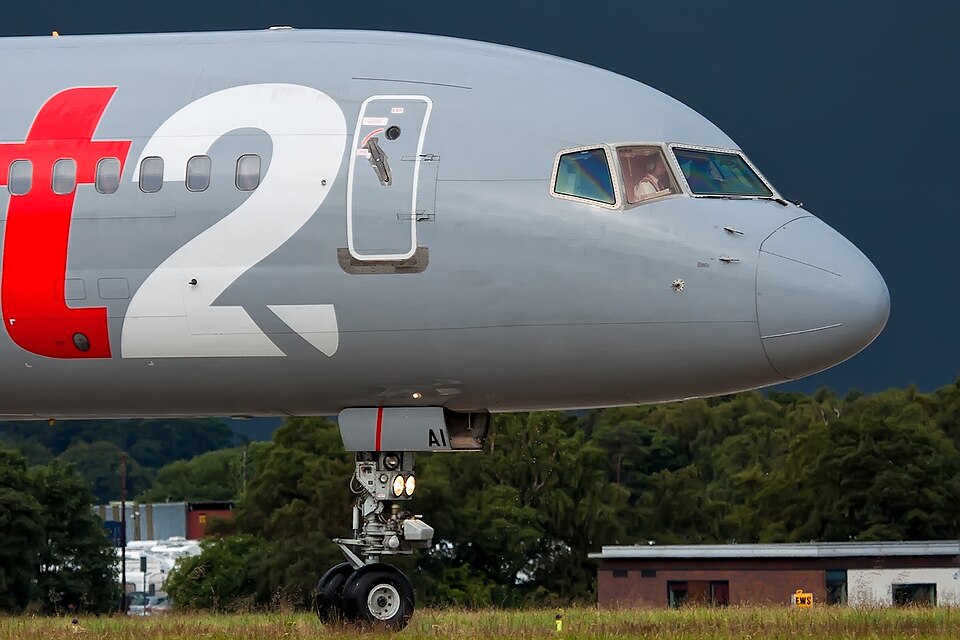
On Saturday, 12 November 2011, at 15:56 UTC, an incident occurred at Tenerife South–Reina Sofía Airport involving two commercial aircraft: an Airbus A321 (registration EC-JMR) operated by Iberia LAE, S.A., and a Boeing B757-21B (registration G-LSAI) operated by Jet2. The A321, callsign IBE3415, was arriving from Paris/Charles de Gaulle and conducting an ILS Y approach to runway 08. The B757, callsign EXS518, had been cleared to proceed to the runway 08 hold point.
The tower controller asked EXS518 if it was ready for immediate takeoff, and the crew replied in the affirmative. The controller cleared the B757 to enter the runway via taxiway B1 for immediate takeoff. IBE3415 reported being on short final, and the controller informed the crew that there was an aircraft taxiing. The controller then authorized IBE3415 to land with the departing traffic in sight. IBE3415 landed on runway 08 as EXS518 became airborne. Both aircraft completed their maneuvers without further incident.
Personnel Information
The tower controller had 11 years of experience and had been qualified at that airport tower since 2004. He had completed the 2011 continuous training, which included a six-hour simulator course; however, the simulator sessions did not include the tower controller position that authorizes arrivals and departures.
Aircraft Information
The B757 Flight Crew Operations Manual recommends a typical taxi speed of about 20 kt, reduced to 10 kt when turning. Performance calculations for that day yielded a takeoff run of 4,095 ft (1,250 m) and a rotation speed of 143 kt. The A321's approach speed typically ranges between 125 and 155 kt for typical commercial weights (60–75 MT). The A321 can be landed in FULL FLAP (40° flaps) or CONF3 (24° flaps); CONF3 requires a speed 5–7 kt higher. The A321's approach speed is classified as ICAO category C.
Meteorological Information
Visibility exceeded 10 km. Surface winds were weak (2–3 kt) from the south, which is atypical for the area—normally strong winds from the east prevail.
Aerodrome Information
Tenerife South Airport has a single asphalt runway (08/26) measuring 3,200 × 45 m. A parallel taxiway (T) has three accesses to the runway 08 threshold: B2, B1, and B0. The control tower is approximately 500 m north of the runway’s geometric center and 1.5 km from the 08 threshold. Runway 08 has a category I ILS approach.
Communications
IBE3415 first contacted the tower at 15:51:58, reporting 14 NM on final and lined up on the ILS. EXS518 contacted at 15:53:41, confirmed readiness for immediate takeoff, and was cleared; the controller offered B2 or B1 access, and the crew chose B1. At 15:55:15, IBE3415 reported short final; the controller replied that there was an aircraft taxiing and then cleared IBE3415 to land with the departing aircraft in sight. No further communications until EXS518 was airborne.
Recorders
Quick Access Recorder data from both aircraft were available and compared with radar data to reconstruct the sequence.
Eyewitness Statements
The controller stated that clearing an airplane for immediate takeoff with another on approach is a typical practice he has used often. He did so on his own initiative to speed up traffic. There was no pressure from EXS518 crew. He could not say exactly how far EXS518 was from the runway entrances due to line of sight. He felt EXS518's maneuvers were slower than usual and the landing aircraft's approach speed was noticeably higher. He was unaware of a written procedure establishing a minimum distance for immediate takeoff clearances, though common practice uses 5 NM. He had doubts about the maneuver but did not amend the clearance.
The IBE3415 crew stated they heard the takeoff clearance and assessed the possibility of a go-around, but since weather was good and the other aircraft was far along in its takeoff run, they continued and landed as EXS518 became airborne. They noted that the A321's landing configuration is commonly CONF3 to save fuel, as the speed difference from FULL FLAP is small.
The EXS518 crew stated they were aware of the approaching aircraft, had visual contact, and did not think it was particularly close. They did not stop during taxi and takeoff and considered the controller's instructions efficient for maximizing capacity.
Decelerated Approach
A decelerated approach delays flap extension to maintain higher speeds. The Iberia Operations Manual recommends this “whenever possible” with good visibility, specifying that the airplane should initiate the final approach in CONF1 (10° flaps) at 180–203 kt and configure by 1,000 ft.
Control of Departures
Spain’s Air Traffic Regulations allow for immediate takeoff clearance before an aircraft is on the runway, requiring it to taxi and take off without stopping. The regulation generally forbids a landing aircraft from crossing the threshold until the preceding departing aircraft has crossed the runway end or started a turn. However, landing can be authorized in advance if adequate separation is assured at threshold crossing, with the clearance not granted until the preceding landing aircraft has crossed the threshold.