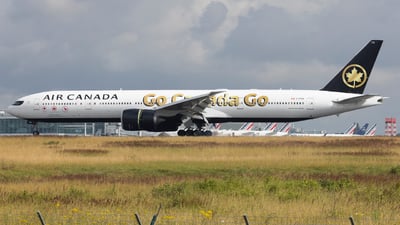
Flight History
On 10 December 2018, at 1041 hrs Toronto local time, an Air Canada Boeing 777-333ER (registration C-FITW) operating as AC15 departed Toronto Pearson International Airport for Hong Kong International Airport on a scheduled passenger flight. As the aircraft approached Hong Kong on 11 December 2018, the crew briefed for the approach and landing. The approach was routine, and the pilot flying disengaged the autopilot after descending through 500 ft above aerodrome elevation. After reverting to manual flight, the approach profile became slightly high above the glideslope. At approximately 200 ft AAE, the aircraft entered a series of minor lateral roll deviations, followed by a pronounced roll first to the left and then to the right in response to the pilot's control inputs.
Ground Contact and Landing Roll
At the runway contact point, the aircraft, rolling left and right with a high rate of descent and a nose-high pitch attitude, experienced a hard landing. The right main landing gear contacted the runway first, followed by the left main gear and the aft lower fuselage. The aircraft bounced, touched down, bounced again, and then landed on the nose gear followed by both main gears. The aircraft completed the landing roll and continued to the parking stand. There were no injuries.
Aircraft Damage
The aircraft, a Boeing 777-333ER, sustained damage to the aft fuselage (Section 47). A damage assessment survey was conducted by Boeing. The report documented the damage to the aircraft structure.
Investigation
The investigation was conducted by the Air Accident Investigation Authority (AAIA) of Hong Kong, with assistance from the Transportation Safety Board of Canada (TSB) as the State of Registry and Operator. The investigation team made seven safety recommendations. Flight data from the flight data recorder, cockpit voice recorder, and an airborne image recorder inside the cockpit were analyzed.
Meteorological and Operational Factors
The ATIS reported windshear and turbulence conditions in the area. Windshear alerts were recorded on the day of the accident flight. The investigation also examined aspects of crew resource management, stable approach criteria, and training related to pilot-induced oscillations and bounced landing recovery.