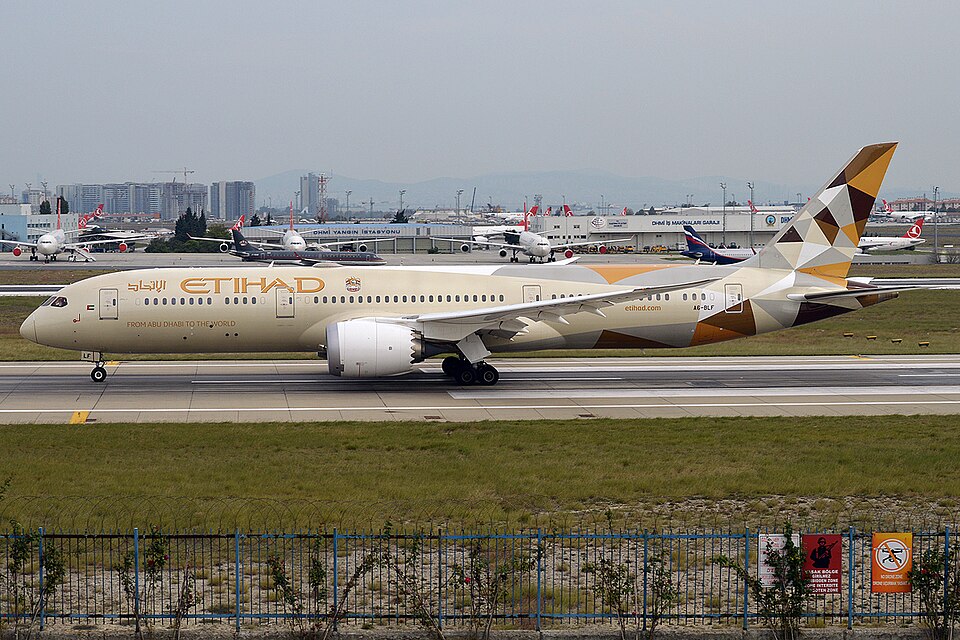
Flight History
On 7 September 2019, a Boeing 787-9 aircraft, registration A6-BLF, operated by Etihad Airways as flight ETD834, was on a scheduled passenger flight from Abu Dhabi International Airport to Hong Kong International Airport. During the approach, air traffic control cleared the aircraft to fly direct to waypoint RIVER and descend to 4,500 ft for an Instrument Landing System (ILS) approach to Runway 25R. The aircraft, with the autoflight system engaged, intercepted the localizer at waypoint RIVER, approximately 15 nautical miles from the runway, on a heading of 292 degrees. After an initial left turn to capture the localizer, the aircraft overshot the intended heading and diverged from the localizer course toward terrain to the north, descending below the Minimum Sector Altitude of 4,300 feet. No Enhanced Ground Proximity Warning System (EGPWS) warnings were triggered. The Pilot Flying disengaged the autoflight system and assumed manual control, re-establishing the aircraft on the ILS heading approximately 11 nautical miles from the runway threshold. The aircraft landed uneventfully. There was no damage to the aircraft and no one was injured.
Aircraft Information
The incident aircraft was a Boeing 787-9 equipped with an autoflight director system. The flight control module (FCM) of this system was found to contain a software problem that caused the localizer capture anomaly.
Investigation Findings
The investigation team, supported by the Air Accident Investigation Sector of the UAE, the NTSB, the Hong Kong Civil Aviation Department, Boeing, and Etihad Airways, analyzed flight data and the localizer capture behavior. They determined that the deviation resulted from a software problem embedded in the FCM of the autoflight director system. The aircraft was in visual meteorological conditions during the approach. ATC communications, navigation aids, and crew qualifications were not factors.
Cause
The investigation team found that this serious incident was caused by a software problem embedded in the flight control module (FCM) of the autoflight director system.
Safety Actions
Following the incident, the Civil Aviation Department of Hong Kong took proactive safety actions including a comprehensive check of the ILS, issuing an Aeronautical Information Circular, a letter to Boeing 787 operators, and a NOTAM. Boeing issued a Flight Crew Operations Manual Bulletin and an Alert Service Bulletin. Etihad Airways distributed flight safety information, communicated with Boeing, and incorporated the Alert Service Bulletin.