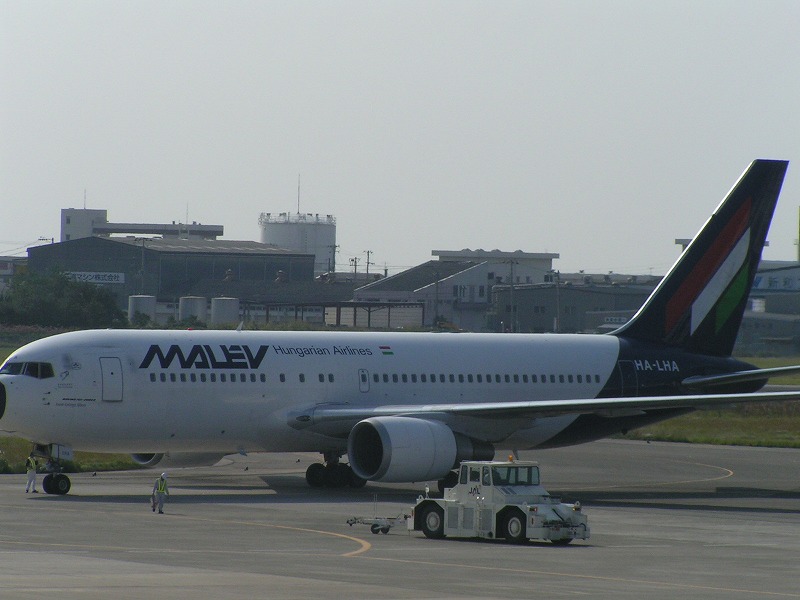
Occurrence
On 9 July 2007, after approximately 7 hours and 50 minutes of flight MAH090 (Budapest–New York), the crew of a Malév Boeing 767-200ER, registration HA-LHA, detected a generator failure on the left engine (engine No. 1) when the GEN DRIVE warning light illuminated. The crew disconnected the generator from the electrical network and started the auxiliary power unit (APU) to maintain a two-generator supply (APU generator and right engine generator). During descent, 40–50 minutes later, the APU generator disconnected from the network. The crew performed a reset procedure which was unsuccessful. Two minutes later, the APU automatically shut down. The crew restarted the APU with the generators switched off (unloaded). The aircraft continued the approach and landed safely at New York John F. Kennedy International Airport without requesting assistance or declaring an emergency. The crew documented the failures on Aircraft Flight Log (AFL) sheet No. 0022815 and requested assistance from contracted maintenance personnel (Delta) for troubleshooting.
Investigation
The Transportation Safety Board (TSB) investigated the occurrence. The investigation reviewed documents related to the case. It was established that both technical issues were examined by the contracted maintenance staff. During troubleshooting, bronze chips were found in the oil system of the No. 2 generator (integrated drive generator, IDG). The IDG was replaced in accordance with maintenance documentation (MM 24-11-01). A serviceability test and leakproofness check of the oil cooling system were performed. The APU was tested on the ground under high electrical load and restarted several times under load, but the indicated failure could not be reproduced. The APU, its generator, and the replaced IDG (and thus the aircraft) were declared airworthy. The work was documented on AFL sheets No. 0022815 and 0022816.
The aircraft operated the return flight (MAH 091) with an instruction to start the APU before descent and report its operation. After 1 hour and 52 minutes of operation, the APU automatically shut down accompanied by an “APU FAULT” warning. The crew documented this on AFL sheet No. 0022818. The aircraft landed safely at Budapest Ferihegy at the planned arrival time.
Findings
Troubleshooting at Ferihegy by ACE maintenance service determined that the APU failure was caused by an internal malfunction of the engine control unit (ECU). This led to fluctuations in APU revolutions or an increase above nominal value. Since the APU generator lacks a revolution-regulating unit, the irregular revolutions caused frequency fluctuations in the generated voltage. The generator control unit (GCU) prevented the APU generator from connecting to the network due to the damaging fluctuating frequency. The ECU was replaced per maintenance manual MM 49-61-05. The work and aircraft airworthiness were documented on AFL sheet No. 0022818.
According to ACE/Malév statistics, the IDG was replaced 31 times on the Boeing 767-200 due to malfunction between 1994 and 2007. Neither the manufacturer’s Maintenance Planning Document nor the specifications classify the IDG as a “hard time” component, but due to frequent malfunctions, the Malév Maintenance Program specified an operational time limit of 12,000 hours, after which the equipment was to be overhauled.
Conclusion
No safety recommendation was issued because the operator had already taken action in response to the occurrence.