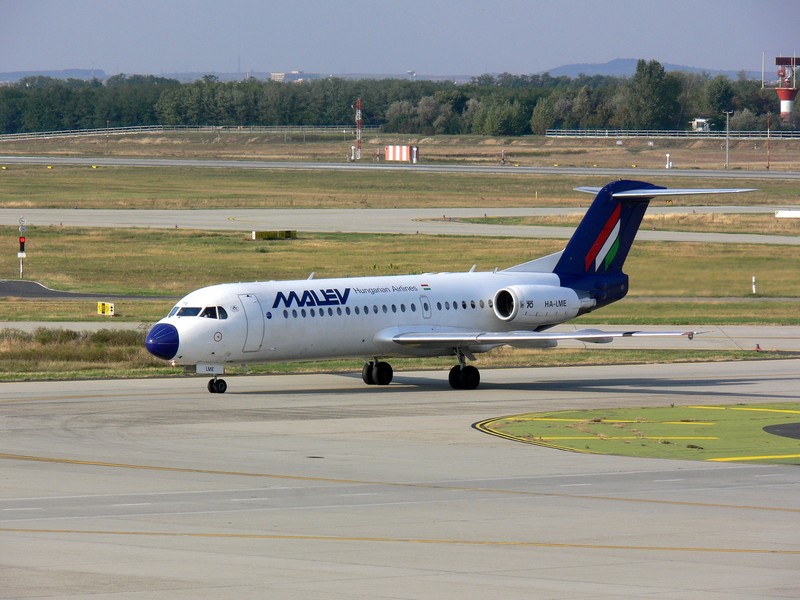
Flight History
On 11 October 2008, a scheduled passenger flight operated by Malév Zrt., registration HA-LME (Fokker F28 Mk 0070), was en route from Goteborg (GOT) to Budapest (BUD) as flight MAH873. The aircraft departed Goteborg at 13:09 UTC. After climbing to cruise altitude, the flight proceeded without anomaly for over an hour. At 14:18 UTC, the left throttle lever, with automatic thrust engaged, began moving toward the idle position without any preceding indication. Within seconds, cockpit warnings illuminated: “N1 OVERSPEED,” “N2 OVERSPEED,” “HIGH TGT,” and “MASTER WARNING.” Engine parameters for the left engine showed high values.
Crew Actions
In response, the flight crew shut down engine #1 at 14:18:50 UTC, following the relevant procedures in the Quick Reference Handbook (QRH). They declared an emergency with air traffic control and initiated a diversion to the nearest suitable airport, Krakow-Balice (EPKK). During descent, the crew attempted an in-flight restart of engine #1; however, as soon as the engine start sequence began, gas temperature and rotational speeds increased rapidly, prompting the crew to abort the restart.
The approach and landing were conducted by the first officer using auto-approach and manual land modes with one engine operative. The aircraft landed without further incident at Krakow airport.
Investigation
The Transportation Safety Bureau (TSB) of Hungary investigated the serious incident. The occurrence was reported to TSB at 17:05 UTC on the same day. TSB assigned an investigator on 18 October 2008. The Polish investigative authority declined to investigate, so TSB assumed responsibility. The investigation was based on documentation and analysis of flight recorder data, as no field investigation was conducted. The aircraft sustained no financially relevant damage, and no injuries were reported among the 2 cockpit crew, 2 cabin crew, and 44 passengers.
As part of the investigation, the operator sent the fuel flow regulator (serial number B2693) for a shop visit to Goodrich Engine Control Systems (GECS). The investigation determined that the aircraft's airworthiness certificate was valid, and the crew held valid licenses and medical certificates. The flight recorders provided useful data for analysis. Meteorological conditions and navigational aids had no bearing on the event.
The investigation focused on the technical aspects of the engine malfunction but did not assign a probable cause in the provided source material.