History of the Flight
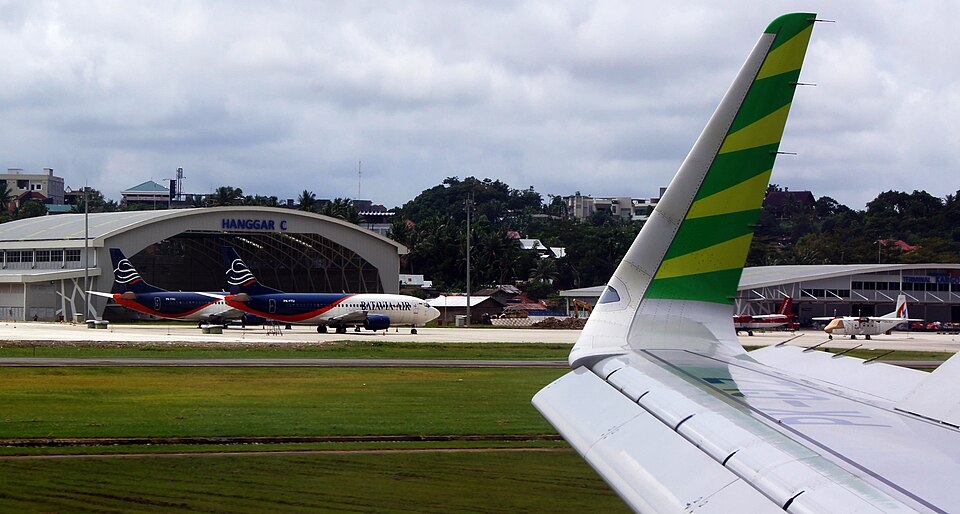
On 7 January 2007, a Boeing Company 737-300 aircraft, registered PK-YTU and operated by Metro Batavia Airline (Batavia Air), was operating scheduled passenger flight 7P-524 from Depati Amir Airport, Pangkal Pinang to Soekarno-Hatta Airport, Jakarta. The flight carried 142 passengers (including 3 infants) and 6 crew members (two pilots and four flight attendants). The pilot in command was the handling pilot, and the co-pilot was the pilot monitoring.
The aircraft blocked off at 09:57 UTC and taxied to runway 16 for departure. At 10:00, while lining up by turning 180°, the pilot heard a sound, which he assumed came from something braking. He decided to return to the apron for inspection. After landing, it was found that the right nose wheel axle shaft was broken and the right nose wheel was missing. The right nose wheel axle shaft and the nose wheel were later found on the runway shoulder approximately 3 meters from the runway.
Damage to Aircraft
The aircraft sustained damage to the right nose wheel axle shaft, which was broken. There was no other damage to property or the environment.
Injuries to Persons
No injuries were reported among the 142 passengers, 6 crew members, or any other persons.
Investigation
The National Transportation Safety Committee (NTSC) conducted the investigation. Examination of the broken axle shaft by the Metallurgy Laboratory of the Institute of Technology, Bandung (ITB) revealed that the initial crack occurred on the lower side of the right nose wheel axle shaft, caused by overload forces. The crack had initiated at ten landings before the occurrence, as indicated by beach marks on the fracture surface.
Safety Actions
Following the incident, the operator and the Directorate General of Civil Aviation (DGCA) took several safety actions:
- Conducted inspections of all Boeing 737 aircraft in the fleet using non-destructive testing (NDT) methods to detect similar damage.
- The Quality Assurance Department reviewed and evaluated maintenance personnel training and trained all ratings holders to improve their knowledge of standard aircraft maintenance practices.
- The Engineering Department reviewed and evaluated all Aircraft Maintenance Manuals (AMM) used for maintenance to ensure their validity and currency.