History of the Flight
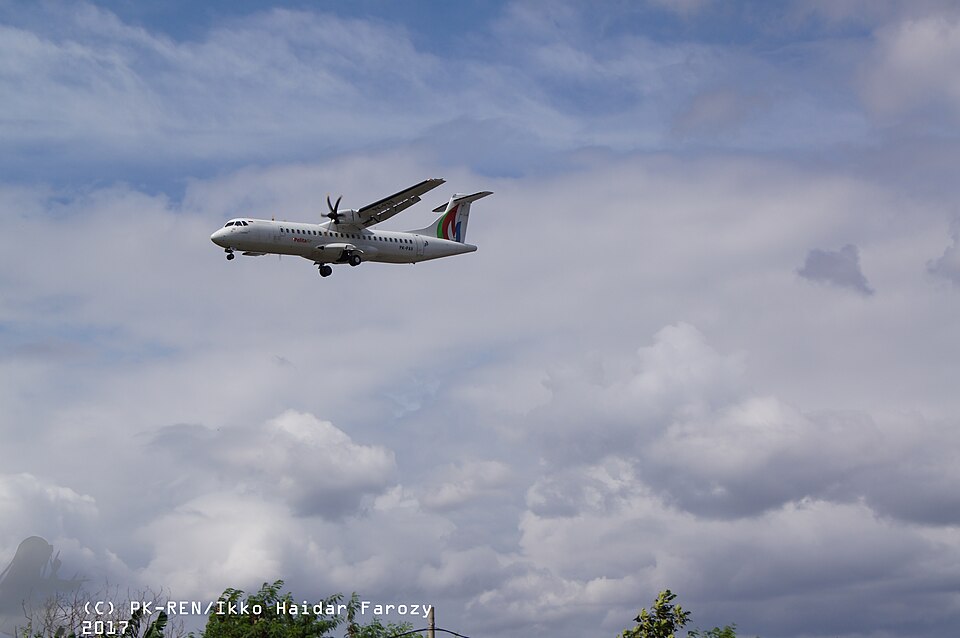
On 19 March 2017, an ATR 72-212A aircraft, registered PK-PAV, was operated by PT. Pelita Air Service as a scheduled charter flight from Tunggul Wulung Airport (Cilacap, Central Java) to Halim Perdanakusuma International Airport (Jakarta). The flight carried two pilots, two flight attendants, and 22 passengers. No aircraft system malfunctions were reported or recorded prior to the occurrence.
The aircraft departed Cilacap at 1313 Local Time (0613 UTC) with the Pilot in Command (PIC) acting as Pilot Flying (PF) and the Second in Command (SIC) as Pilot Monitoring (PM). The flight was uneventful until the approach. The occurrence occurred during daylight conditions.
At 0752 UTC, the crew established contact with Halim Tower, reporting descent to 2,500 feet at 10 nautical miles from the AL NDB. The tower cleared the crew for an Instrument Landing System (ILS) approach and requested a report when established on the localizer.
At 0758 UTC, the crew reported passing 1,500 feet. The tower reported wind from 270 degrees at 4 knots and issued landing clearance.
At approximately 500 feet altitude, the autopilot disengaged and the pilot flew manually. At about 200 feet AGL, the flight data recorder (FDR) recorded the yaw damper turning off.
As the aircraft approached the runway, the Enhanced Ground Proximity Warning System (EGPWS) called out "TEN." Shortly after, the cockpit voice recorder (CVR) captured the PM calling "speed check."
At 0801 UTC, the aircraft touched down, 14 seconds after the EGPWS callout. The Halim Tower controller observed the aircraft touching down near the intersection of taxiway G, approximately 800 meters from the runway threshold, and then bouncing. The aircraft came to a stop near the intersection of taxiway A.
Damage to Aircraft
Inspection revealed damage to the nosewheel: both nosewheel tires were blown out, the nosewheel hubs were scraped by the runway surface, and the nosewheel axle was bent. Additionally, cracks were found on the engine mounting strut bar and shock damper of both engine number 1 and number 2.
Personnel Information
Details of the flight crew are included in the preliminary report. The PIC and SIC held appropriate licenses and had no reported issues.
Meteorological Information
At the time of landing, the wind was reported as 4 knots from 270 degrees.
Flight Recorders
Both the Flight Data Recorder (FDR) and Cockpit Voice Recorder (CVR) were recovered and provided data for the investigation.
Organizational Information
The operator, PT. Pelita Air Service, issued safety actions following the incident. The Komite Nasional Keselamatan Transportasi (KNKT) issued safety recommendations regarding monitoring systems for stabilized approach procedures.
Conclusion
This preliminary report contains factual information only and does not include analysis or conclusions. The investigation is continuing.