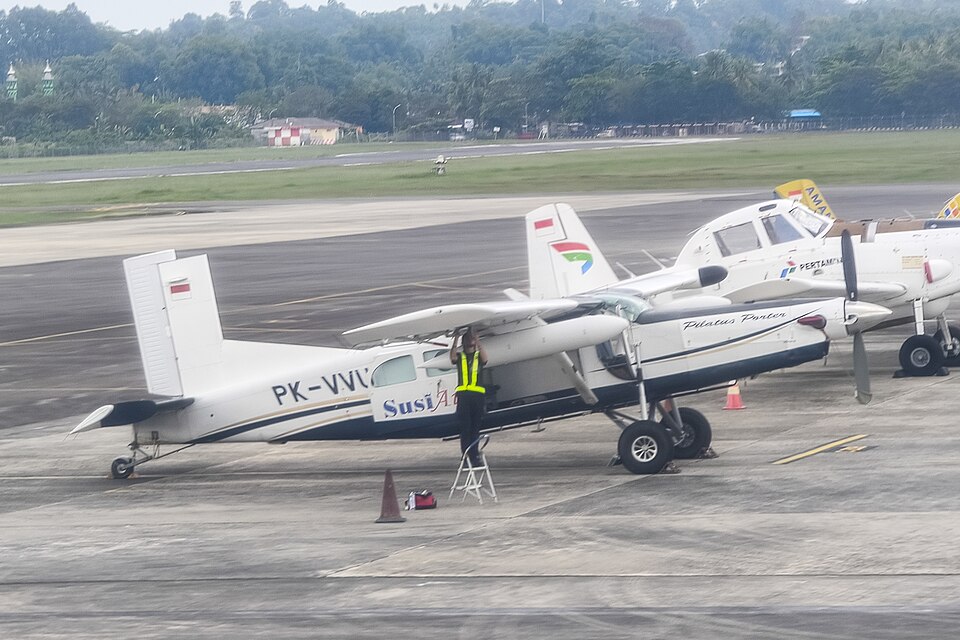
History of the Flight
On 12 July 2023, a Pilatus PC-6/B2-H4 aircraft registered as PK-VVU, operated by PT Asi Pudjiastuti Aviation (Susi Air), was scheduled for a series of flights in North Kalimantan, Indonesia. The first leg was from Juwata International Airport (WAQQ) in Tarakan to Long Layu Airstrip (WAQU). The aircraft carried cargo and only the pilot was on board.
Due to rain at Long Layu the previous night, the pilot delayed departure by approximately two hours to allow the runway to dry. The aircraft took off from Tarakan at 1026 local time under daylight conditions and cruised at 10,500 feet. The flight was uneventful until the approach to Long Layu.
During the approach, the pilot flew over the runway and joined a circuit pattern to assess runway condition. Typically, a 15° offset was used on final approach to Runway 19 to avoid trees near the threshold. On this day, the pilot reduced the offset to less than 15° to align with the runway earlier, aiming to improve directional control and landing distance on a potentially slippery wet runway.
On final approach, the pilot felt an impact on the right wing. The aircraft's speed and attitude remained normal, so the pilot continued and landed successfully. After stopping, a walk-around inspection revealed a dent on the leading edge of the right wing, indicating contact with tree branches. No injuries were reported, and the aircraft sustained minor damage.
Pilot Information
The pilot was a South African national holding a valid Commercial Pilot License and a Class I medical certificate with no limitations. The last proficiency check was on 9 April 2023. The pilot had a total of 2,517.2 flight hours, including 254.6 hours on the Pilatus PC-6/B2-H4. The pilot had flown to Long Layu many times, most recently one week before the incident.
Aircraft Information
The aircraft was a Pilatus PC-6/B2-H4, serial number 967, manufactured in 2009. It was registered as PK-VVU with valid Certificates of Airworthiness and Registration. The aircraft had accumulated 8,161.1 flight hours and 11,853 cycles since new. Its engine was a Pratt & Whitney PT6A-27.
Aerodrome Information
Long Layu Airstrip (WAQU) is located in a hilly area. Runway 19 had a hill with vegetation on the short final path, as depicted in the investigation report. The approach required offsetting to avoid obstacles. The investigation identified the presence of unmitigated hazards (trees) near the airstrip.
Investigation Findings
The investigation found that the pilot deviated from the typical approach path to avoid potentially hazardous conditions on a wet runway. The right wing struck tree branches during final approach. Contributing factors included unmitigated tree hazards near the airstrip and the absence of detailed approach procedures in the Area Reference Booklet provided to the pilot.
Safety Recommendations
The Komite Nasional Keselamatan Transportasi (KNKT) issued safety recommendations for Susi Air to develop detailed approach procedures and collaborate with the airstrip operator to regularly assess and mitigate risks, ensuring safe flight operations.