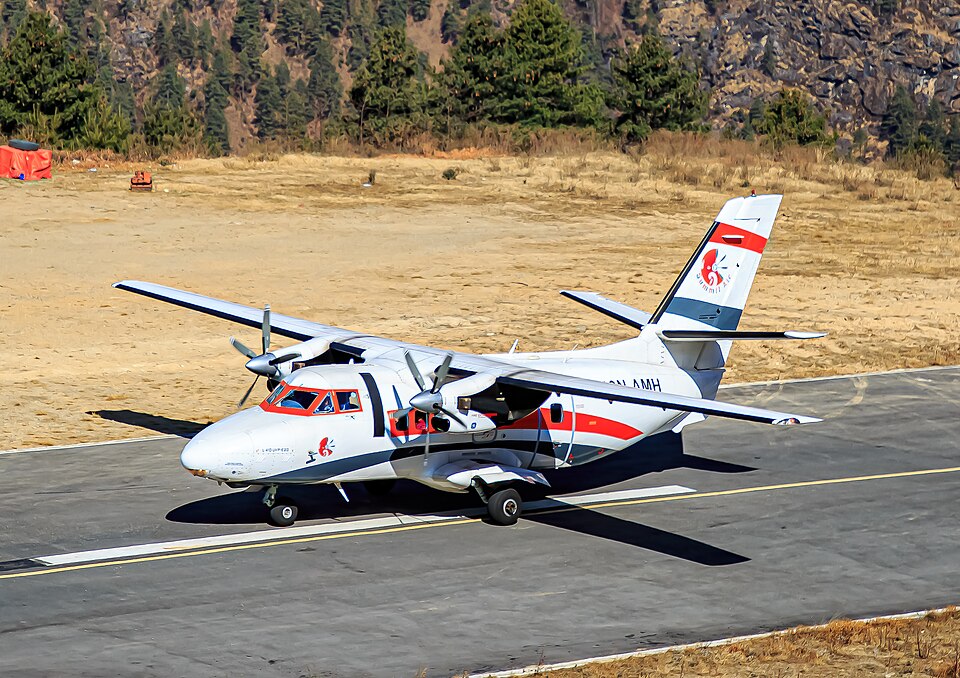
Accident Overview
On 14 April 2019, at approximately 0322 hours, an Aircraft Industries L410UPV-E20 (registration 9N-AMH) operated by Summit Air Pvt. Ltd. experienced a runway excursion during take-off roll from runway 24 at Tenzing-Hillary Airport, Lukla. The aircraft veered right, departing the runway, and struck two parked helicopters before coming to a stop.
Sequence of Events
The aircraft had completed three flights on the Ramechhap-Lukla-Ramechhap sector prior to the accident. After arriving from VNRC (Ramechhap) at 0315 hours, the captain (pilot monitoring) shut down the left engine. Following cargo and passenger unloading, he restarted the left engine at approximately 0318 hours. At 0322:30 hours, the captain aligned the aircraft with the runway threshold of runway 24 and handed controls to the co-pilot (pilot flying) for take-off. The take-off roll began at 0322:50 hours. Within three seconds, as captured by CCTV footage, the aircraft veered right and departed the runway.
Wreckage and Impact
The aircraft traveled 42.8 feet across the grass to the right of runway 24, struck the airport inner perimeter fence, then skidded 43 feet into the upper helipad. It first collided with Manang Air's helicopter AS350B3e (registration 9N-ALC), which had its rotor blades at idle, and then struck Shree Airlines' helicopter AS350B3e (registration 9N-ALK). The right wing of the L410 swept two security personnel on the ground before slashing the rotor shaft of the helicopter 9N-ALC. The rotating blades cut through the right side of the cockpit, killing the co-pilot instantly. The helicopter 9N-ALC toppled onto the lower helipad 6 feet below. The left wing of the aircraft broke the skid of helicopter 9N-ALK, and the aircraft came to a halt with the toppled 9N-ALC beneath its right main wheel assembly. Helicopter 9N-ALK shifted about 8 feet laterally and sustained minor damage. There was no post-crash fire.
Injuries and Damage
The captain and cabin crew of 9N-AMH survived. The co-pilot and one security personnel were killed on the spot, and a second security personnel died later in the hospital from injuries. All three deceased were Nepalese citizens. The crew of helicopter 9N-ALC sustained a broken tail-bone, while the crew of 9N-ALK escaped without major injuries. Aircraft 9N-AMH and helicopter 9N-ALC were substantially damaged; helicopter 9N-ALK incurred partial damage.
Probable Cause
According to the official investigation, the probable cause of the accident was the aircraft veering right during the take-off roll due to asymmetric power resulting from an abrupt rearward movement of the right power lever and the crew's failure to abort the takeoff. Insufficient evidence existed to determine the exact reason for the abrupt power lever movement. Contributing factors included the co-pilot's failure to immediately assess and react, a time lapse before the captain could intervene, and asymmetric braking resulting from pedal position during the captain's corrective actions.