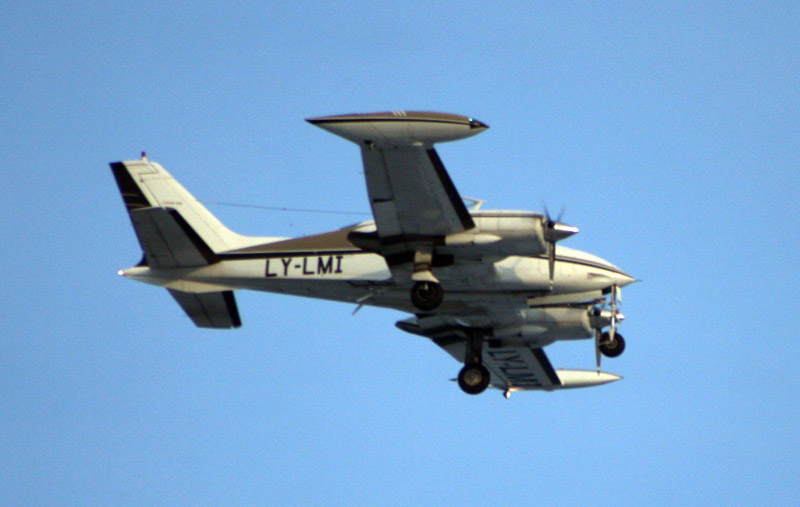
Incident Overview
On August 14, 1998, at approximately 12:15 local time, a Cessna-310 with registration LY-LMI suffered an accident while landing at Šilutė aerodrome. The aircraft was owned and operated by the VGTU A. Gustaičius Aviation Institute. The flight crew consisted of a chief pilot instructor in the left seat and a student pilot in the right seat, accompanied by two passengers.
Flight Progression
The aircraft departed Vilnius International Airport at 11:01 local time, one hour later than planned, with fuel for seven hours of flight. The flight plan indicated an IFR leg to NDB Skaudvilė followed by a VFR leg to Šilutė for training purposes. Upon approaching the aerodrome, the crew established radio contact on 125.000 MHz. Air traffic control reported wind from 270° at 5-6 m/s and recommended landing on the parallel grass runway. However, lacking specific information regarding the condition of the grass surface, the crew elected to approach and land on the asphalt runway.
Accident Sequence
The crew approached the aerodrome at 1,000 feet with a heading of 270°. They extended the landing gear and set flaps to 15 degrees, completing the fourth turn at 500 feet. During the final approach, the crew deployed full flaps (35 degrees). Airspeed initially ranged between 95-100 knots, increasing slightly to 100-105 knots as they passed trees before gradually decreasing to 90 knots. As the aircraft neared the flare point, engine RPMs were reduced to minimum levels.
At an altitude of 10-15 meters, the aircraft began to sink rapidly, triggering the stall warning. Both pilots attempted to correct the attitude by aggressively pulling back on the control yokes. This action resulted in a high vertical descent rate, evidenced by deep tire marks of 20-25 cm depth. The landing gear struck the rear safety strip 5-6 meters from the runway threshold. Moments later, the gear hit the runway threshold itself, causing both propellers to strike the asphalt surface.
The impact deformed the left engine mounting nodes, lowering the front of the left engine by approximately 20 cm relative to the longitudinal axis. The runway threshold acted as a ramp, launching the aircraft back into the air. It traveled 18 meters before landing again on the asphalt, with the left propeller striking the ground a second time. After the roll-out, the crew steered the aircraft to the left, stopped it, and shut down the engines.
Damage and Consequences
The accident resulted in significant damage to the aircraft but no injuries to the four persons on board. Third-party property damage was not reported. Post-accident inspection revealed extensive structural damage, including deformation of the left wing center section, bent propeller blades on the left engine (approximately 20 cm), and damaged landing gear attachment nodes. The left engine nacelle and fairings were deformed, and the left aileron control linkage was broken. Additionally, the fuselage skin on both sides showed buckling, and the baggage compartment latch was broken. The crew reported that they could not exit through the doors due to deformation and had to leave via the baggage hatch with external assistance.
Environmental and Operational Context
Meteorological data from 11:00 local time indicated wind from 280° at 5 m/s, visibility greater than 10 km, and cumulonimbus clouds with a base at 300 meters. Pilots noted that the wind felt significantly stronger after exiting the aircraft. The Šilutė aerodrome features two parallel runways aligned on a 090-270° heading: an asphalt runway measuring 500 meters in length and 30 meters in width, and a grass runway of 800 meters by 300 meters. The investigation noted that the decision to use the asphalt runway was justified given the aircraft's landing distance requirements (approximately 180 meters for takeoff roll and 517 meters total stopping distance under standard conditions) and the presence of headwinds.