History of the Flight
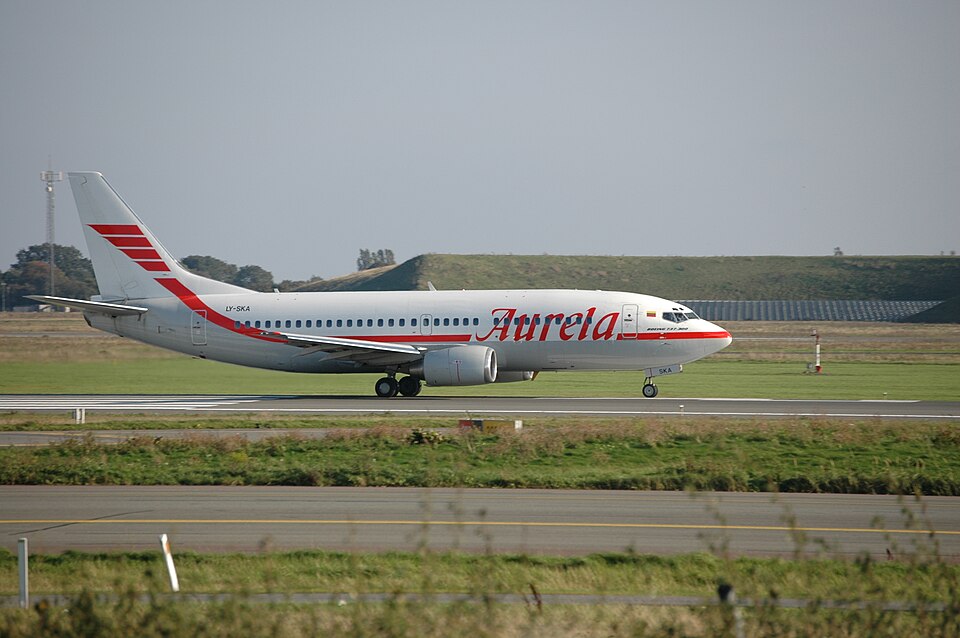
The aircraft, a Boeing 737-35B registered LY-SKA, was operating a scheduled passenger flight from Nice Airport, France, to Birmingham International Airport. The commander, who held an Airline Transport Pilot's Licence, was the pilot flying. During the arrival briefing, he selected Autobrake 2 and planned to vacate Runway 33 at Taxiway Bravo.
After an uneventful approach, the aircraft landed within the touchdown zone at an indicated airspeed of 137 kt. The runway was wet, and the wind was from 010° at 6 kt. During the landing roll, the commander judged the aircraft would not decelerate sufficiently to vacate at Taxiway Bravo without excessive braking. He disconnected the Autobrake using the brake pedals just before Taxiway Bravo, cancelled thrust reverse, released the brakes, and rolled to the end of the runway to vacate at Taxiway Alpha.
As the aircraft approached Taxiway Alpha, the commander began turning at about 12 kt. Initially, the aircraft responded as expected, but during the turn it became uncontrollable and skidded towards the left edge of the taxiway. The commander applied full brake pedals, but the aircraft departed the paved surface onto adjacent grass and stopped.
ATC had cleared a following aircraft to land as LY-SKA began vacating the runway. Shortly after, the crew of LY-SKA informed ATC they had stopped on the grass, and the following aircraft was instructed to go around.
After stopping, the pilots started the APU and shut down the engines. They confirmed no injuries. Passengers and crew disembarked via the right rear door using steps provided by the airport operator.
Examination
An engineering examination revealed cuts in the tyre tread, probably from travelling over the grass. The nosewheels and tyres were replaced. No hydraulic leaks were found, and brake system components were undamaged. Brake wear pins were within limits. A built-in test of the anti-skid system showed no faults. Main gear oleo extensions were symmetrical.
Runway Friction Measurements
Birmingham International Airport conducted a surface friction assessment after the incident using a Grip Tester Mark II. The overall friction level for the entire runway paved surface was 0.80, with the central portion slightly lower. No point on the runway had friction below the Maintenance Planning Level for more than 100 m. The results were consistent with a previous assessment in June 2012.
A friction assessment of the taxiway surfaces at each end of the runway was also performed. A small area near the Alpha One stop-bar had friction below the Minimum Friction Level (MFL) of 0.55. The average value for the surveyed area exceeded 0.70. The nose and right main gear traversed this reduced-friction area for a maximum distance of approximately 5 m.
Recorded Information
The aircraft was fitted with a Flight Data Recorder (FDR) and a two-hour Cockpit Voice Recorder (CVR). The FDR recorded 18 parameters but did not include thrust reverser, braking, steering, or ground speed parameters. Closed-circuit television showed the aircraft touched down within the touchdown zone. FDR data confirmed deceleration after touchdown at around the Autobrake 2 target of 0.155g. Approximately 25 seconds after touchdown, the deceleration profile indicated pedal braking override of Autobrake, followed by release of the brake pedals for 18 seconds as the aircraft coasted towards Taxiway Alpha. At a calculated groundspeed of 36 kt, further pedal braking was applied just before the turn. The maximum rate of turn occurred at a calculated groundspeed of 21 ± 3 kt, reducing to 14 ± 3 kt as the nosewheel left the taxiway.
Analysis
The operator's operations manual stated that a groundspeed of approximately 10 kt should be used for turns from a runway onto a non-high-speed taxiway in dry conditions. As the runway and taxiway were wet, a lower speed would have been appropriate. The aircraft commenced the turn from the runway above 20 kt. It was considered unlikely that the small area of reduced friction on Taxiway Alpha had a significant effect on the outcome.
The commander was reluctant to cause the following aircraft to go-around due to a previous experience where he had been admonished for slow runway vacating. However, he did not know the exact distance or time remaining for the following aircraft. In the event, the following aircraft was instructed to go-around because LY-SKA had not completed the turn successfully.
Conclusion
The aircraft departed the paved surface of the taxiway because it turned to vacate the runway at a speed inappropriate for the conditions.