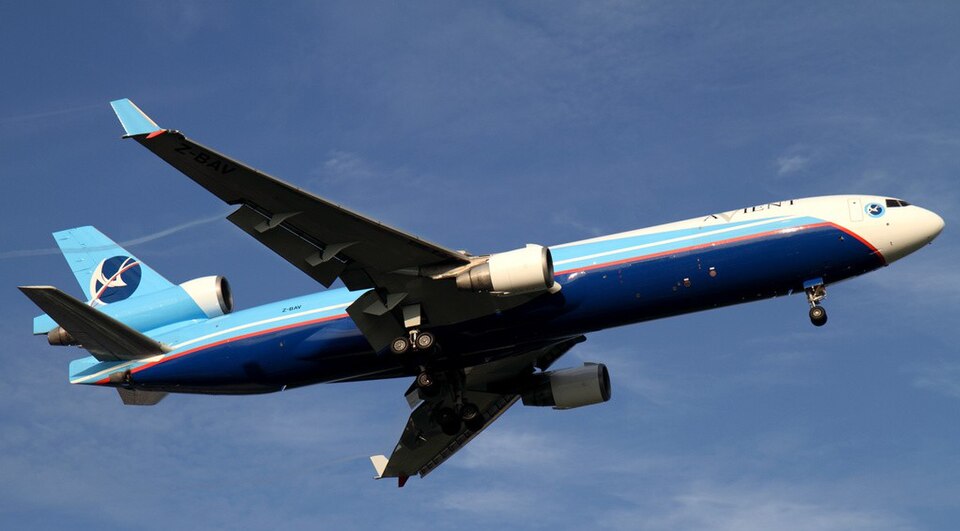
Accident Overview
On an unspecified date, a three-engine MD-11 cargo aircraft operating a flight from Shanghai-Pudong Airport to Bishkek, Kyrgyzstan, crashed during takeoff. The aircraft was carrying various goods and seven crew members. Three crew members were killed and four others injured. The aircraft was totally destroyed.
Sequence of Events
During the takeoff roll from runway 35L, the pilot-in-command initiated rotation, but the aircraft did not lift off properly and had a negative vario. It overran the runway and came to rest in an open field.
According to the official investigation, the crew did not properly operate the thrust levers, so the engines did not reach takeoff thrust. The aircraft had not reached Vr at the end of the runway and could not become airborne. The MD-11 design requires at least two thrust levers to be pushed beyond 60 degrees to trigger autothrust to leave CLAMP mode and adjust thrust to the takeoff target. During the accident departure, the pilot in the left seat did not advance the thrust levers beyond 60 degrees; thus the servo motors did not move the levers forward, and autothrust remained in CLAMP mode without increasing thrust.
Crew members perceived anomalies: weak engine sound, low airspeed, and less seatback pressure than normal. Someone on the observer seats suggested the aircraft might be heavy. The T/O THRUST page never appeared, and no click sound or lever movement was felt. The crew lost situational awareness and did not act on these cues.
As the aircraft approached the runway end, several options existed: reject takeoff and close throttles, continue with throttles to the mechanical stop, or rotate immediately. The observer called "rotate," and the captain rotated, but since Vr had not been reached, the aircraft could not get airborne. Simulator verification showed that had the crew pushed the thrust levers to maximum thrust when they recognized the abnormal situation, they would have become airborne 670 meters before the runway end; had they rejected takeoff, the aircraft would have stopped before the end.
Probable Cause
The crew did not properly operate the thrust levers so that the engines did not reach takeoff thrust. The aircraft had not reached Vr at the end of the runway and could not get airborne.
Contributing Factors
The crew did not follow standard operating procedures for managing thrust on takeoff. The left-seat pilot failed to advance the thrust levers and incorrectly called "thrust set." The captain, responsible for thrust management per company manual, was reportedly filling out forms and not monitoring the aircraft during the critical phase. All crew members had long duty hours prior, including a 16-hour sector and extensive travel from Europe and America, inducing fatigue. The co-pilot (pilot flying for the accident sector) was 61 years old with hypertension and cardiovascular atherosclerosis. The captain had flown the Airbus A340 for 300 hours in the last six months, which has different autothrust handling (thrust levers do not move with automatic thrust), possibly leading him to ignore the MD-11 levers. The co-pilot had been an MD-11 captain for seven years but not flown the type for a year. Both pilots were on their first flight for the occurrence company. The two observer pilots had zero flight hours in the previous six months. The investigation also noted significant design weaknesses in the MD-11 throttle system, with insufficient self-checks and automation.