Flight Details
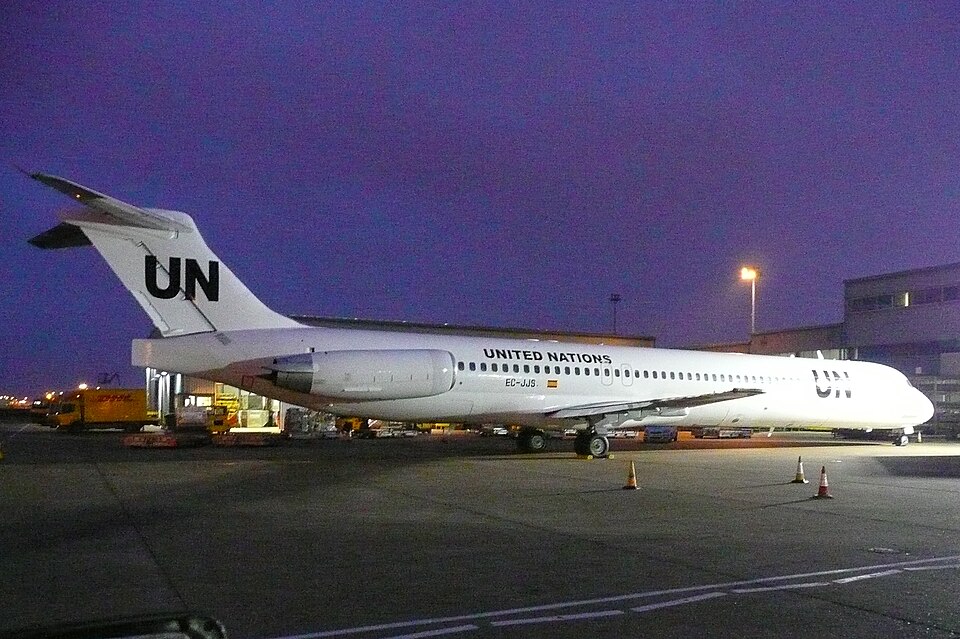
On 24 January 2012, a McDonnell Douglas MD-83, registration EC-JJS, operated by Swiftair on behalf of Gryphon Airlines, conducted a scheduled passenger flight from Dubai International Airport, United Arab Emirates, to Kandahar Airport, Afghanistan, under callsign SWT094. The aircraft carried 86 passengers (including a company mechanic), three flight attendants, and two cockpit crew members. The crew was picked up from their hotel in Ras al-Khaimah at 21:00 and flew empty to Dubai, departing at 00:20 UTC. After customs and boarding, the aircraft was refueled for the return trip and took off from runway 30R at 02:08 UTC, following a standard instrument departure RIKET2D and climbing to flight level 290. The first officer was the pilot flying.
Approach and Landing
At 03:42, over waypoint SERKA, the crew was transferred to Kabul control and descended to FL280. Reporting an ISAF callsign (ISF39RT), they were vectored to point SODAS and transferred to Kandahar control at 03:46, reducing speed to 250 knots. Kandahar control cleared them for an RNAV (GPS) approach to runway 05, direct to the initial approach fix FALOD, with a descent to 6,000 feet. The ATIS broadcast indicated runway 05, wind 060° at 17 knots gusting to 24 knots, visibility 1,200 meters, scattered clouds at 2,700 feet, broken at 3,000 feet, temperature 1°C, dewpoint -7°C, and QNH 30.06 inHg. The tower later radioed similar wind conditions: 060° at 15 knots gusting to 21 knots. The crew reached FALOD in instrument meteorological conditions (IMC) and did not exit clouds until 1,500 feet above the minimum descent altitude of 3,700 feet (394 feet AGL). They visually acquired the runway 500 feet above minimums and noted being slightly right of the centerline. The captain, having more experience at Kandahar, took over controls. The Precision Approach Path Indicator (PAPI) was out of service, so the crew relied only on visual references. During short final, they corrected the lateral deviation to the left. At 03:58, during the flare, the aircraft shifted left, prompting the captain to apply right roll. This caused the right wing tip to strike the ground before the wheels touched down. The captain considered it a hard landing; the first officer suspected contact. The autopilot and autothrottle were engaged until visual acquisition and touchdown, respectively.
Aftermath
After exiting the runway, tower personnel who witnessed the ground contact ordered the crew to stop and informed them of the damage. Firefighting services were dispatched, requiring engine shutdown. Once no fuel leak or damage to wheels or brakes was confirmed, the crew restarted engines and taxied to the stand. The wing had contacted the ground approximately 20 meters prior to the runway threshold, destroying five threshold lights and damaging the right wing. Passengers were reportedly unaware of the incident and disembarked normally.
Investigation and Probable Cause
The official investigation determined that the accident was likely caused by the failure to observe company operating procedures and not executing a go-around when the approach was clearly not stabilized. Additionally, the operator lacked authorization and the crew lacked training for the RNAV (GPS) approach to runway 05 at Kandahar. A contributing factor was the inoperable PAPI, which could not assist the crew in establishing the correct descent slope.