What happened
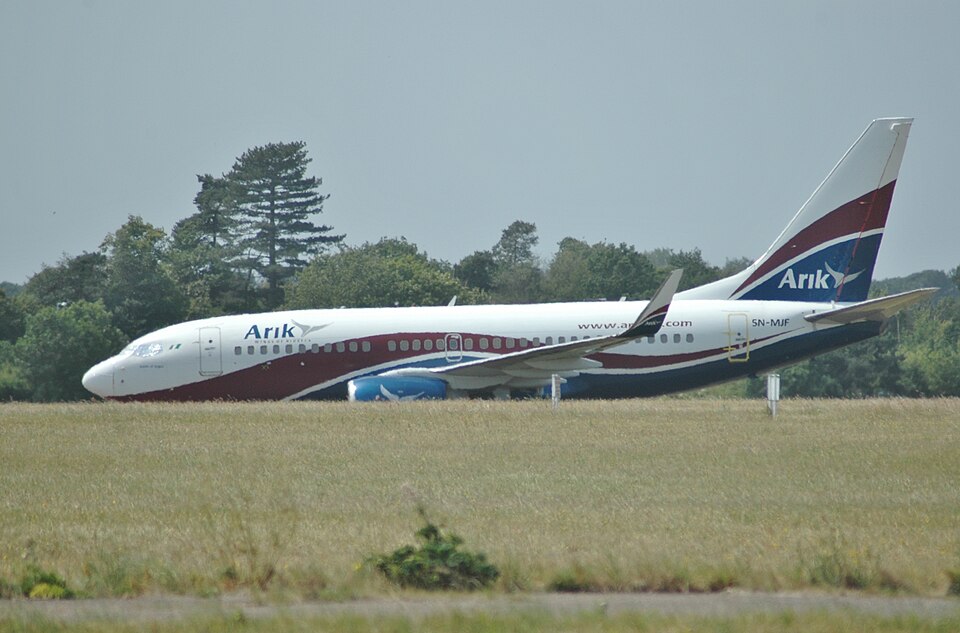
On February 11, 2026, Arik Air Limited flight ARA740, operated by a Boeing 737-700 aircraft bearing registration 5N-MJF, departed Murtala Muhammed International Airport (DNMM) in Lagos bound for Obafemi Jeremiah Awolowo International Airport (DNPO) in Port Harcourt. The flight carried seven crew members and eighty passengers.
Shortly after takeoff, while climbing through Flight Level 260 toward Flight Level 290 under visual meteorological conditions, the crew heard a loud bang followed by severe vibration and an abnormal grinding noise originating from the left engine. The aircraft veered left and began to decelerate. The autopilot was immediately disconnected, and the crew assumed manual control.
Assessing the situation, the flight crew identified severe damage to the No. 1 engine. They executed an emergency shutdown procedure in accordance with their Quick Reference Handbook and declared a Mayday. Air Traffic Control advised diverting to Benin City Airport (DNBE) due to its proximity. The First Officer transferred control to the Captain as they navigated toward the alternate airport.
During the descent, the crew performed an orbit to manage altitude and completed emergency checklists. Concerns regarding low-speed handling prompted a visual inspection request via the cabin crew. The aircraft landed safely on Runway 23 at Benin City Airport without incident. All passengers disembarked normally with no injuries reported.
The investigation
The Nigeria Safety Investigation Bureau (NSIB) was notified immediately and dispatched investigators to the site. Post-occurrence assessments were conducted under the Civil Aviation Regulations 2023 and ICAO Annex 13 standards. Investigators retrieved the Flight Data Recorder (FDR) and Cockpit Voice Recorder (CVR), downloading data successfully at the Transport Safety Laboratory in Abuja.
A preliminary inspection of the aircraft on the apron at Benin City revealed extensive damage to the left engine and surrounding airframe structures. Key observations included:
- The No. 6 fan blade was broken with its root remaining attached, while the other 23 fan blades were chipped or damaged.
- Engine inlet cowling was missing, and both inboard and outboard cowlings were folded upward.
- Deep cuts and cracks were observed on the engine containment case.
- The engine-driven pump clamp was loose, and the pump itself sustained damage.
- Outlet Guide Vanes at multiple positions were missing.
- Significant structural damage was noted on the left wing leading edge, horizontal stabilizer, vertical stabilizer, and rudder.
The investigation team is currently conducting metallurgical examinations of the fan blades and preparing for a full teardown of the No. 1 engine to determine the root cause of the failure.
Findings
As this is a preliminary report, final conclusions have not yet been established. However, initial findings confirm:
- The flight crew held valid licenses and medical certificates.
- The aircraft possessed a valid Certificate of Airworthiness.
- The First Officer was the Pilot Flying at the time of the incident.
- The No. 6 fan blade of the No. 1 engine was missing upon landing.
- Maintenance records indicate the engine had undergone recent ultrasonic inspections with no defects found prior to the flight.
Safety action
No specific safety recommendations or actions have been issued at this preliminary stage. The investigation remains ongoing, and the final report will detail any necessary safety interventions.