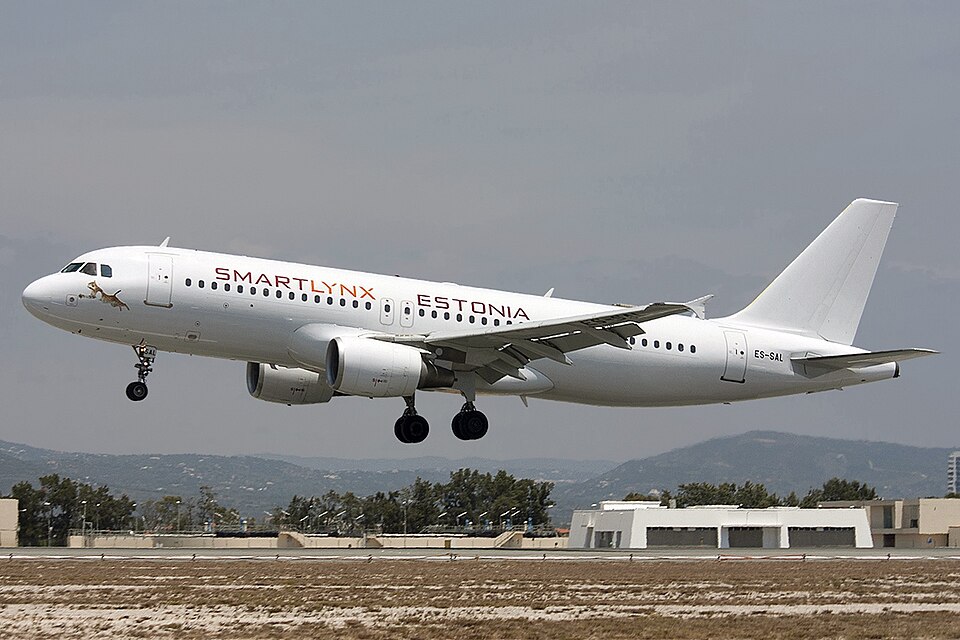
On July 31, 2014, an Airbus 320 (registration ES-SAL) was involved in an aviation accident near Tallinna Lennuväli, EE. This summary draws on records from the Estonian Safety Investigation Bureau (OJK).
On July 31, 2014, an Airbus A320 operated by SmartLynx Airlines Estonia OÜ tailstruck runway 08 at Tallinn Airport during landing. The incident was classified by the Estonian Safety Investigation Centre.
Incident Overview and Classification On July 31, 2014, at 11:45 local time, an Airbus A320 with registration ES-SAL, operated by SmartLynx Airlines Estonia OÜ, experienced a tailstrike on runway 08 at Tallinn Airport during landing. The Estonian Safety Investigation Centre (OJK) classified the event as an incident and determined that a formal safety investigation was not necessary or beneficial. Instead, OJK compiled factual material to allow relevant parties to analyze the event and implement corrective measures. ## Operational and Meteorological Conditions The runway was dry, and reported meteorological conditions were CAVOK, with a temperature of 28°C and wind from 180 degrees at 19 knots, gusting to 21 knots. The captain held a valid ATPL(A) license and Class 1 medical certificate, with 6,996 total flight hours, including 6,060 hours on the A320 and 3,505 hours as A320 captain. The first officer held a valid ATPL(A) license and Class 1 medical certificate, with 428 total flight hours, including 179 hours as A320 first officer. The aircraft had a valid airworthiness certificate and airworthiness review certificate, and its mass and center of gravity were within manufacturer limits. ## Approach and Landing Sequence During the approach to runway 08 at 08:46 GMT, the captain, acting as pilot monitoring, requested a weather update from air traffic control. The control center reported wind from 190 degrees at 15 knots, gusting to 21 knots. Because the crosswind component exceeded the operator's limit for pilots with less than one year of type experience, the captain assumed the role of pilot flying. The captain performed the flare, and at the moment of main gear touchdown, the aircraft's pitch angle was 9.8 degrees. The aircraft bounced off the runway. The captain decided to continue the landing procedure and increased the pitch angle to stabilize the situation. When the pitch angle reached 12.7 degrees, the tail of the aircraft struck the runway 525 meters from the displaced threshold, before the main gear touched down. The impact dented the tail cover panel and a drain pipe. After landing, the aircraft was taxied to the apron and parked. ## Operator Analysis and Contributing Factors Following the incident, the operator analyzed potential causes. The analysis suggested that the incident may have been caused by the flight crew not accounting for wind variability (windshear) during the flare or failing to abort the landing in accordance with manufacturer procedures. The analysis also suggested that the crew did not abort the landing when the aircraft bounced, contrary to manufacturer procedures. Additionally, the analysis pointed to Tallinn air traffic control not accounting for a potential wind tunnel effect and not assigning runway 26 for landing. The analysis also noted that wind information provided by Tallinn air traffic control may have been inaccurate due to the incorrect placement of wind sensors at Tallinn Airport, with the anemometer located 357 meters from the runway threshold and the landing area beginning 800 meters from the threshold. ## Manufacturer Procedures and Flight Data According to manufacturer procedures (A320 Flight Operations Briefing Notes), a bounce may be caused by windshear, strong thermal air currents, high vertical speed, late flare, incorrect flying techniques, or excessive landing speed. Recommended procedures in the event of a bounce include maintaining a normal touchdown angle, avoiding an increase in touchdown angle, or aborting the landing (go-around). The aircraft's airspeed at initial main gear contact with the runway was 130 knots, and the vertical acceleration was 1.6 G, which was within the limits described in SmartLynx OM-B. ## Meteorological Sensor Location and Data Analysis According to the Aeronautical Information Publication (AIP, effective July 24, 2014), the landing area (TDZ) for runway 08 begins 151 meters from the displaced threshold, and the aiming point (AIM) is 384 meters from the displaced threshold. The AIP stated that the runway 08 anemometer is located 357 meters from the runway threshold (THR). However, the actual location of the anemometer at Tallinn Airport is 357 meters from the displaced threshold. According to Jeppesen data, the total length of Tallinn Airport runway 08 is 2,820 meters, of which 2,209 meters can be used following the glide path. The aiming point (AIM) is therefore 611 meters from the runway threshold, or 361 meters from the displaced threshold. Based on meteorological information provided by air traffic control and data from the operator's Flight Data Monitoring Program, it is possible that the wind direction on runway 08 changed rapidly during the incident. Because the end of runway 08 at EETN borders a lake, this may cause changes in wind direction and/or strength under certain meteorological conditions. However, there was no confirmation that this phenomenon could be considered a cause of the incident or a contributing factor. Based on camera recordings and marks left by the aircraft's tail on the runway (525 meters from the displaced threshold), it can be concluded that the pilots of SmartLynx Estonia aircraft ES-SAL followed the glide path, and the first contact with the runway occurred at the landing point, near which the anemometers are located. Therefore, the operator's claim that the landing point and anemometer location at Tallinn Airport differ to such an extent that the flight crew had no opportunity to receive adequate wind information was not confirmed. It was confirmed that the AIP contained misleading information about the anemometer location. A corresponding correction to the AIP was initiated by Tallinn Airport. The change took effect on February 8, 2015.