History of the Flight
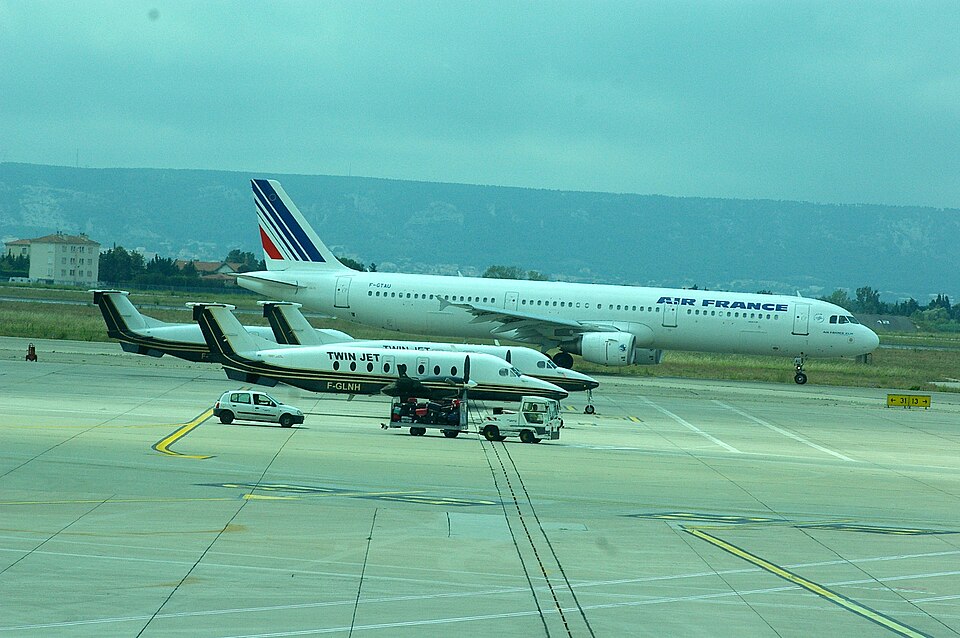
On 10 December 2021, a Beech 1900D registered F-GLNH operated by Intairline departed Toulouse-Blagnac at 17:45 on a commercial passenger flight to Metz-Nancy-Lorraine. The co-pilot was the pilot flying. At 18:05, while at FL 180, the crew received clearance to head directly to Clermont-Ferrand. Shortly before reaching Clermont-Ferrand, the aircraft encountered turbulence associated with altocumulus cloud tops. The crew requested a climb to escape the turbulence and were cleared to FL 190, then FL 220.
While climbing through FL 200, the AP TRIM FAIL warning light illuminated. The co-pilot disconnected the autopilot, causing the aircraft to pitch up steeply and climb about 500 ft. He used the manual elevator trim control to return to level flight but found the trim deflection limited and the elevator control difficult to move. With significant force, he managed to restore level flight. The captain then took the controls and noted that abnormal force was needed on both the elevator control and the manual elevator trim to change pitch. After finding suitable power, pitch, and trim settings to maintain level flight, the captain handed controls back to the co-pilot. The crew executed the AP TRIM FAIL procedure and decided to continue to destination.
The crew reported trim and icing issues to ATC, requesting descents to FL 200, then FL 180, and finally FL 150. The rest of the flight was flown manually. During the ILS approach for runway 22 at Metz-Nancy-Lorraine, the aircraft was configured earlier than usual. The elevator control remained stiff but controllable. During the flare, as power was reduced, the co-pilot observed the elevator control unjam and the friction point disappear. The aircraft landed at 19:45, and after parking, full elevator deflection was possible.
Meteorological Information
Before departure, a heavy rain shower with gusts passed over Toulouse for about ten minutes. The crew taxied and took off about 15 minutes after the squall. Météo-France reported unstable cumuliform clouds with rain or snow showers along the route. The AROME model indicated a risk of moderate icing from FL 040 to FL 200 and severe icing around FL 050, but the crew did not observe any icing and did not use de-ice systems. At FL 180 and above, the aircraft was above precipitation areas with temperatures as low as -35°C at FL 220. The crew stated that when the AP TRIM FAIL light came on, they were in clear sky conditions.
Crew Information
The 46-year-old captain held a Commercial Pilot License (CPL) since 2007, with about 5,310 total flight hours, including 753 on type. The 28-year-old co-pilot held a CPL since 2017, with about 1,540 total hours, including 760 on type. Both had received initial type ratings in May/June 2019 and had flown together for 300-400 hours. They had completed e-learning on Beech 1900 abnormal and emergency procedures in April 2020.
Aircraft Information
The aircraft was a Beech 1900D with registration F-GLNH. The report indicates that the elevator control system experienced hardness and the elevator trim jammed during the incident. The AP TRIM FAIL warning light is associated with the autopilot trim system. The crew reported that the elevator control could be fully deflected after landing. A light flow of water was observed from drains under the wings, elevator, and vertical stabilizer after landing, but no visible icing on leading edges.
Additional Observations
The co-pilot noted that he had encountered a similar phenomenon in 2020 on another Twinjet Beech 1900. The crew did not detect any anomalies during pre-flight checks. The captain stated he was unaware of the phenomenon. The event required the crew to use abnormal force on controls throughout the flight until unjamming occurred during the flare.