What happened
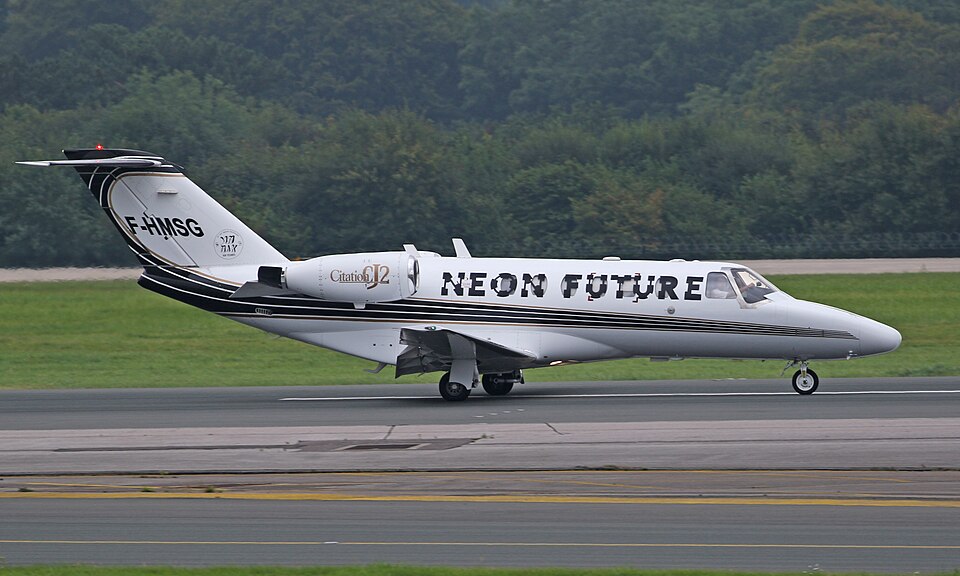
On 28 October 2023, a Cessna 525A Citation CJ2, registered F-HMSG, departed Paris - Le Bourget for Farnborough, United Kingdom. Shortly after takeoff, the crew attempted to retract the landing gear, which triggered an abnormal noise and indicated a malfunction. While the main landing gear indicators showed green, the nose landing gear remained in an unlocked state, with the red Gear Unlock light illuminated.
The crew performed emergency procedures, including using the standby extension system and executing a pull-up maneuver to attempt to unblock the gear, but the nose gear failed to lock. To mitigate the risk of fire during a potential nose-first impact, the crew spent approximately two hours holding at low altitudes to burn off as much fuel as possible. After a low-altitude pass over the runway to visually confirm the gear status, the crew decided to land at Le Bourget. At approximately 00:15, the aircraft landed on runway 25, with the main gear touching first followed by the nose. There were no fatalities or injuries, and the aircraft sustained only slight damage.
The investigation
The BEA investigation focused on the maintenance history and the sequence of events leading to the gear blockage. The aircraft had recently undergone maintenance at a nearby facility. Investigators found that the nose gear door's connection points had not been properly reinstalled.
Further examination of the maintenance facility revealed that the technicians had used adhesive tape to secure the gear doors temporarily and had failed to reconnect the structural components. The investigation also highlighted issues within the maintenance organization, including inadequate supervision and a lack of clear responsibility among staff during shift changes.
Findings
Investigators determined that the primary cause of the incident was the failure to properly reinstall the nose gear door hardware following maintenance. The use of adhesive tape to hold the doors in place was a temporary measure that was never corrected.
Contributing factors included a lack of oversight at the maintenance facility and a breakdown in communication during technician handovers. Additionally, the crew's decision to land at an airport with available services was noted, though the primary failure lay in the maintenance's failure to return the aircraft to a safe configuration.