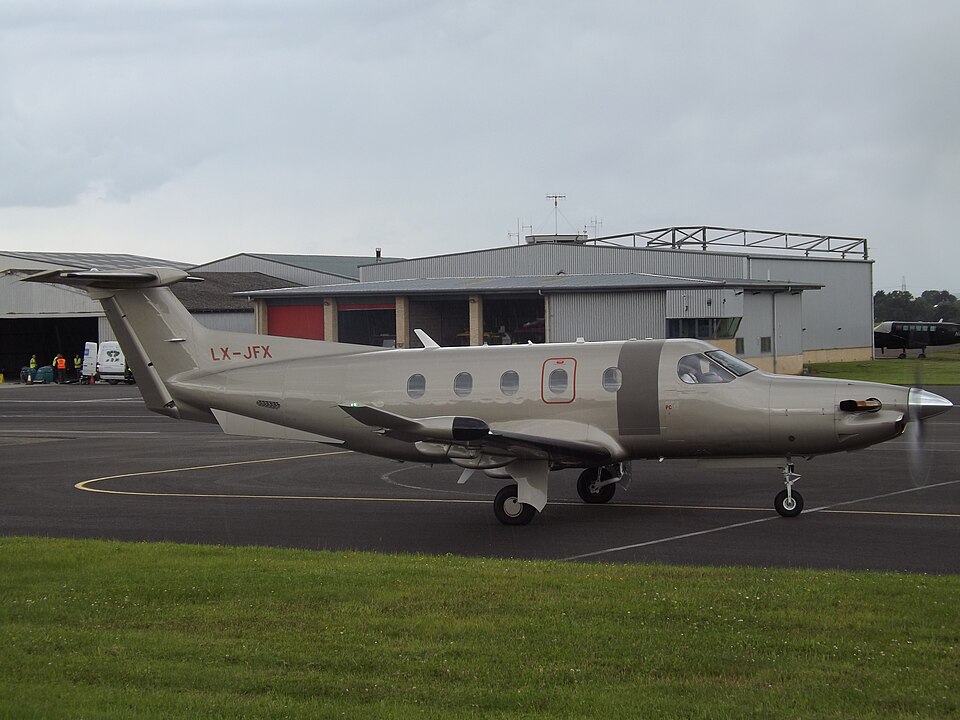
History of the Flight
On 20 October 2021, the crew of a Pilatus PC12/47E, registered LX-JFX, departed Dieppe-Saint-Aubin aerodrome around 18:00 local time for a flight to Brive-Souillac airport under IFR rules. The aircraft carried a captain, co-pilot, and three passengers.
During the descent with the autopilot engaged, the aircraft exited a cloud mass and encountered severe turbulence. Shortly after, approaching another cloud mass at about 3,000 ft, the pilot flying (PF) disengaged the autopilot and executed a sudden avoidance maneuver to the right. The speed decreased, and the stall warning sounded. The PF increased power, leveled the wings, and re-engaged the autopilot. The aircraft lost 550 ft of altitude. The PF then returned to 3,000 ft and continued the approach, landing at 19:37 without further incident.
Meteorological Conditions
The flight file, published before the first flight, included METAR reports, TAF forecasts, and significant weather charts (SIGWX). The forecasts underestimated instability; SIGWX charts did not mention towering cumulus (TCU) or cumulonimbus (Cb) clouds, nor turbulence. The TAF at 05:00 UTC for Brive-Souillac indicated CAVOK with temporary broken clouds at 4,000 ft. Later TAFs suggested possible TCUs and Cbs. The last METAR before take-off (15:30 UTC) reported CAVOK with temporary reduced visibility and scattered TCUs. The METAR at 16:30 UTC indicated Cbs.
About ten minutes before the incident, the Brive controller reported wind 5 kt from 170°, visibility >10 km, few clouds at 5,000 ft, scattered at 5,500 ft, broken at 7,000 ft, a few Cbs, temperature 20 °C, QNH 1013.
Crew Information
The 40-year-old captain held a CPL(A) with MCC training, logging 2,300 flight hours (1,500 on PC12, 600 as captain). He had been with the operator for six years and captain on the PC12 for one year. The 28-year-old co-pilot held a CPL(A) with MCC, logging 1,700 flight hours (550 on PC12). She had been with the operator for 1.5 years.
Aircraft Information
The PC12 is a single-pilot aeroplane with capacity for nine passengers. LX-JFX was equipped with a Honeywell Primus Apex avionics system and an RDR2000 weather radar, which displays precipitation intensity (magenta for intense, red for strong, yellow for moderate, green for weak). The radar does not have a turbulence display function. The aircraft was not equipped with optional RDR2060 radar or XM Weather system.
Flight Recorders
European regulations did not require a flight recorder for this operation. The PC12/47E was equipped with a Cockpit Voice and Flight Data Recorder (CVFDR), but no usable data could be retrieved due to a power supply failure. An Aircraft Condition and Monitoring System (ACMS) provided data at one point per minute, allowing reconstruction of the flight path.
Statements
The captain stated this was his first day of his rotation after a positioning flight. Pre-flight weather indicated good conditions, but ATIS before descent mentioned Cbs. He checked weather radar, which showed only green and orange echoes. After exiting a green cloud, they encountered severe turbulence. The co-pilot suggested a diversion, but the captain continued descending. The co-pilot saw a threatening cloud mass ahead; the captain did not see it clearly in night conditions. He performed a manual avoidance turn. The autopilot was capturing 3,000 ft and power was reduced. He heard "STALL STALL" but no stick pusher or shaker. Speed was about 120 kt. No EGPWS warning. He leveled wings and increased power.
The co-pilot noted she had been working for six days and had performed two flights that day.