What happened
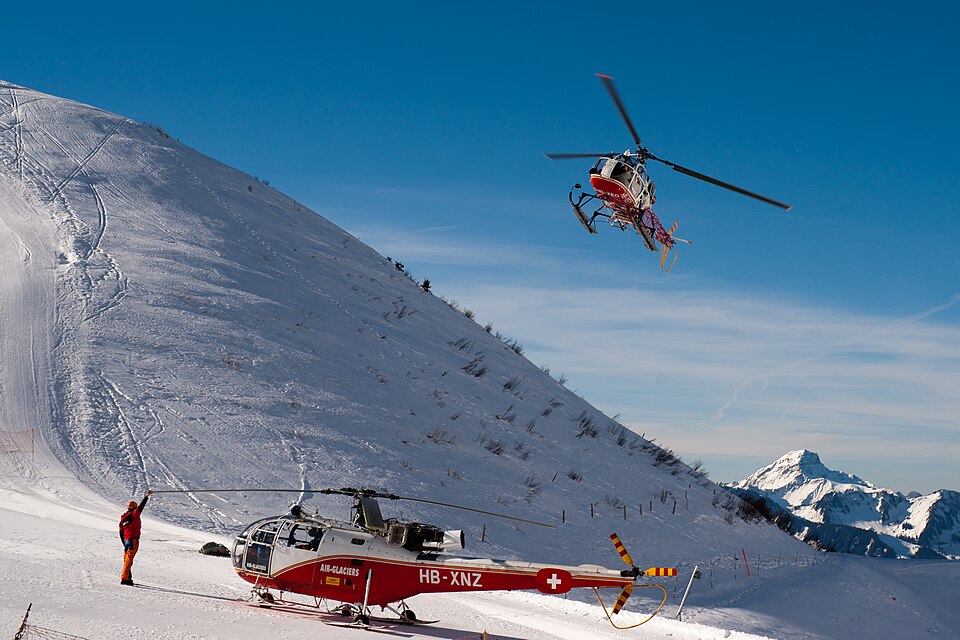
On October 13, 1993, a pilot operating an SA 315B "Lama" helicopter, registration HB-XEO, for Air-Glaciers SA was conducting construction support flights. The aircraft had been deployed since early August to transport materials and assemble pylons for the reconstruction of the Château-d'Oex-La Braye cable car system. On this specific day, the pilot departed from the Saanen airfield at 10:40 local time, arriving at the worksite near Pra Perron, located approximately one kilometer southeast of Château-d'Oex, by 10:43.
Upon landing, the pilot and ground crew conducted a briefing to organize the continuation of the work. After completing two assembly flights and two transport flights, the helicopter landed again to change slings. The pilot received a signal from a ground assistant indicating readiness for another assembly flight. At this point, the forest edge was approximately ten meters to the right, and an old cable car cable stood eight meters directly ahead.
During takeoff, the pilot executed a 180-degree rotation to orient the aircraft away from the forest edge. As the rotation concluded with the old cable positioned behind the helicopter, the tail rotor struck the cable. The impact caused an immediate loss of yaw control. Recognizing the lack of pedal authority and the challenging terrain, the pilot waited for the aircraft to face uphill before attempting a landing. The helicopter touched down normally on uneven ground, completing a final 30-degree rotation but remaining upright on its skids.
The investigation
The Swiss Transportation Safety Investigation Board (SUST) examined the operational context and the sequence of events. The pilot held a valid professional helicopter license with extensive flight experience, totaling nearly 20,000 hours. Medical evidence indicated no impairment affecting his performance. The aircraft was airworthy for day visual flight rules commercial operations at the time of the incident.
The investigation focused on why the collision occurred despite prior knowledge of the site hazards. The pilot stated that while he was fully aware of the cables' presence, intense concentration on the repetitive assembly tasks caused him to momentarily overlook the specific location of the old cable during the maneuver.
Findings
The accident resulted from two primary factors:
- Loss of Situational Awareness: The pilot forgot the presence of the known obstacle (the old cable) due to high cognitive load from the complex task, leading to a collision between the tail rotor and the cable.
- Constrained Operating Environment: The takeoff area was narrow, requiring precise maneuvering in close proximity to obstacles, which increased the risk during the rotation phase.
The pilot sustained no injuries. The helicopter suffered significant damage to the tail rotor, stabilizer, shock absorbers, and landing skids.
Safety action
No specific safety recommendations were issued in this final report beyond the standard investigation conclusion that the accident was caused by the collision with a known obstacle during a constrained maneuver.