Accident Details
On 28 August 1965 at approximately 1510 local time, a Piper J3C Cub HB-OSW was taxiing from the small parking area toward runway 32 at Bern-Belp Airport. At the same time, a Fokker F-27 HB-AAU was being prepared for a Swissair flight to Geneva. The chief of the ground crew, standing about 13 meters in front of the Fokker's nose, was signaling the aircraft to start its engines. The pilot of the Piper Cub, having noticed the airliner and that its right propeller had begun to turn, stopped about 13 meters in front of the Fokker and about 10 meters from the crossing point of its longitudinal axis. Assuming he could proceed in front of the stationary aircraft, he resumed taxiing, turning slightly to the right. After moving about 12 meters, the two occupants of the Cub felt a violent jolt and saw a figure thrown against the left wing and fall to the ground. The ground crew chief had been struck by the Piper's propeller and was killed.
Aircraft Information
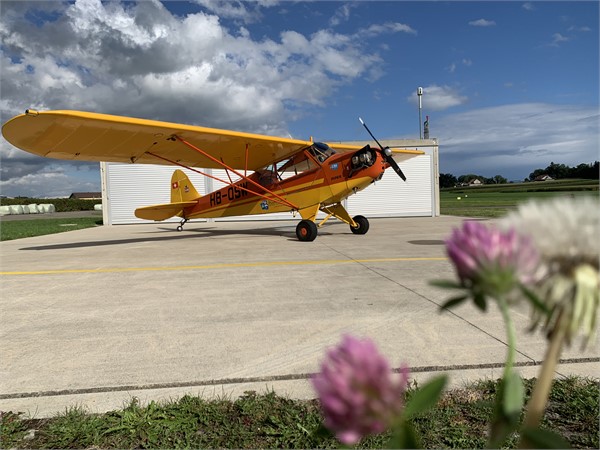
The Piper J3C Cub HB-OSW was a single-engine, high-wing monoplane with a fixed tailwheel landing gear, manufactured in 1945. It was equipped with a Rolls Royce C-90-8f engine and a two-bladed metal propeller. The aircraft had no radio. The pilot occupied the front seat; the passenger sat in the rear. The left side of the cockpit was fixed, while the right side had a sliding window that could be opened for better visibility. The aircraft's forward visibility was limited: objects 12 meters ahead were visible only if taller than three meters, and the blind spot width at that distance was about 7-8 meters.
Pilot and Passenger
The pilot, born in 1944, held a private pilot license valid until 13 March 1966. He had about 60 flight hours, all on the same aircraft type and mostly from Bern-Belp Airport. The passenger, also born in 1944, was a school friend with no aviation experience. No health issues were found in the pilot at the time of the accident.
Environment and Airport Conditions
The accident occurred on the large concrete apron used for airliners, near the control tower side. The area was undergoing construction, and a portion of the taxiway was barricaded. The parking zones lacked painted markings for taxi routes. The weather was fair with light south wind, visibility about 20 km, and sun azimuth 232° with elevation 40°. The ground crew chief wore a red cap as identification and was standing on the apron's edge.
Contributing Factors
The pilot had planned a direct taxi route across the apron. He noticed the airliner but did not see the ground crew member, who was alone and directly in his path. The pilot's forward visibility was restricted by the aircraft's design. The airport organization had not implemented special measures to oversee light aircraft taxiing near the airliner handling area during the construction period. Taxi procedures allowed the use of the apron area, and no marshaling service was provided for aircraft without radios.
Probable Cause
The accident was primarily due to the pilot, while taxiing under difficult conditions, not sufficiently verifying that the path ahead was clear, and secondarily to the lack of safety measures within the aircraft handling and airport organization.