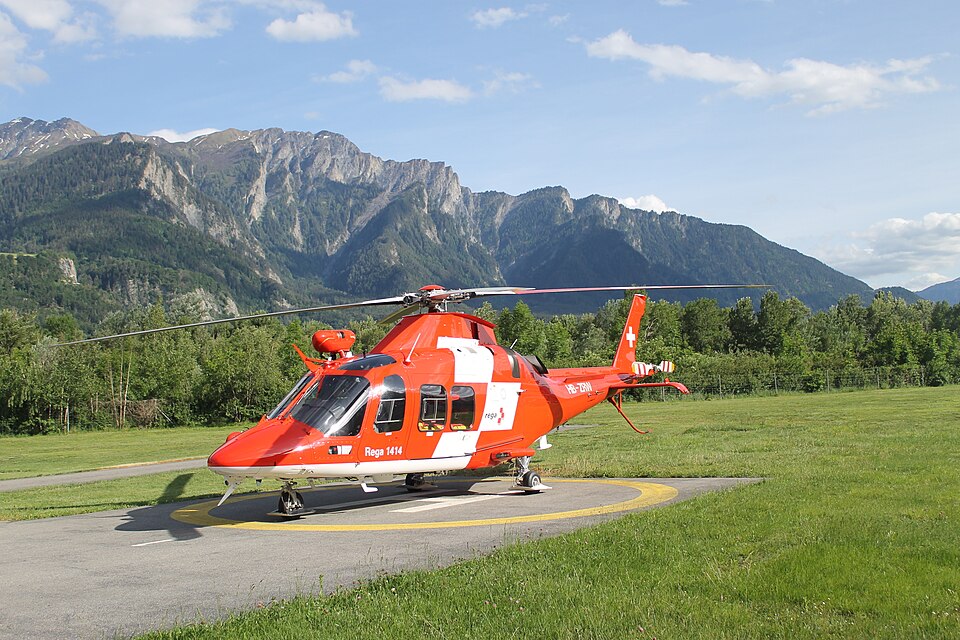
Incident
On 5 May 2018 at 15:52 local time, an AgustaWestland AW109SP helicopter registered as HB-ZRW and operated by the Swiss Air Ambulance (Rega) experienced a fire in the baggage compartment shortly after departing from Salginatobel, Switzerland, for a return flight to the Rega base at Untervaz (LSXU). The crew, consisting of one pilot, one emergency physician, and one paramedic (HCM), had just completed a rescue mission involving a winch operation. During the mission, a vacuum mattress with a rescue bag had been placed on top of other equipment in the baggage compartment. Shortly after takeoff, the crew noticed a smell of burnt rubber but saw no smoke or cockpit warnings, and continued the flight. After landing at 15:57, while preparing for a subsequent mission, the HCM opened the baggage compartment and discovered the rescue bag singed and the ceiling lining darkened. The pilot then shut down the engines and cut the electrical power. The helicopter was removed from service for investigation.
Investigation
The Swiss Transportation Safety Investigation Board (STSB) conducted a summary investigation. The baggage compartment was accessible only from outside. Behind the ceiling lining, which was made of electrically conductive carbon-fiber composite material, were circuit breakers (CBs) protected by orange rubber mats. The ceiling lining was held by screws and was deformable upward. The investigation found that the fire was caused by an electrical short circuit between a protruding rivet head on a hinge of a cover panel and the terminal of a generator circuit breaker. This occurred because the baggage compartment had been loaded up to the ceiling lining, causing deformation that allowed the rivet head to contact the CB terminal. The rubber protection mat was perforated and showed burn marks. It could not be determined whether the perforation occurred on the day of the incident or pre-existed, but similar damage found on a sister helicopter suggested pre-existing damage. The short circuit created an arc that ignited the rubber mat and then welded the cable lug to the rivet, causing high currents that burned the ceiling lining at various locations. Due to the short time between the short circuit and its discovery, no electrical system failure, tail rotor control loss, or fire in the carried equipment occurred.
Actions Taken
Following the incident, Rega inspected all its AW109SP helicopters and applied Teflon tape to the rivets on the hinge bands of the cover panels. On 28 May 2018, the manufacturer Leonardo S.p.A. Helicopters issued Service Bulletins 109SP-120 and 109S-079, recommending installation of spacers between the helicopter structure and the ceiling lining and advising against loading the baggage compartment until the modification. The European Aviation Safety Agency (EASA) then issued Emergency Airworthiness Directive 2018-0120-E, mandating compliance within 15 flight hours.
Conclusion
The STSB concluded that the serious incident was caused by an electrical short circuit between a protruding rivet head in the electrically conductive and deformable ceiling lining of the baggage compartment and a circuit breaker located behind it, after the compartment was loaded up to the ceiling. The safety deficiency was promptly addressed by the operator, manufacturer, and EASA, so no safety recommendations were issued.