What happened
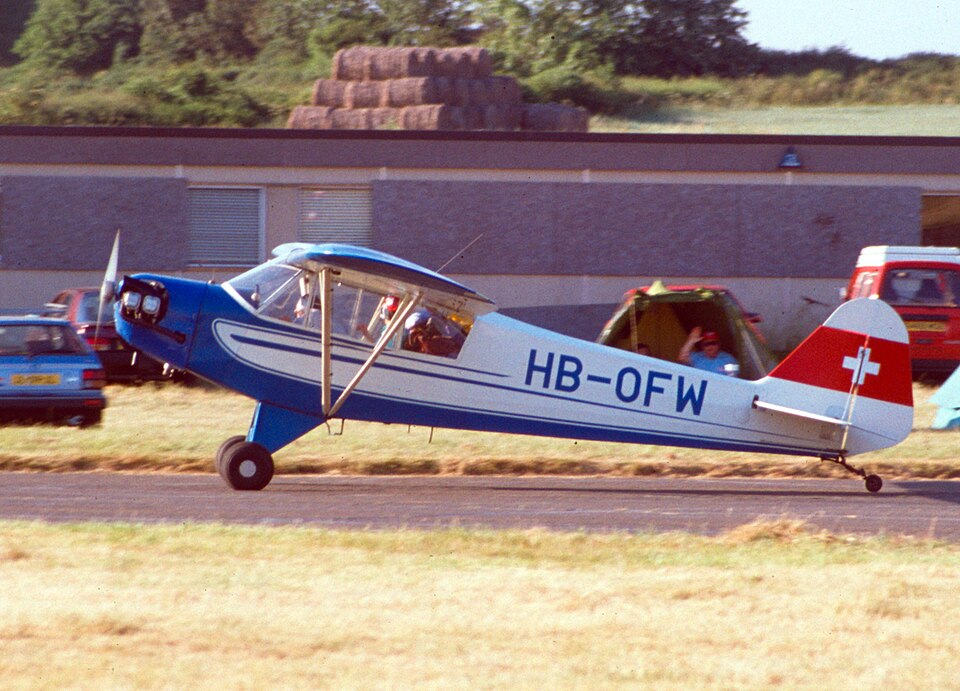
On July 8, 1962, a pilot and one passenger departed from Wangen-Lachen in a Piper Cub J3C (HB-OFW) for a private flight intended to traverse the Albulapass. After passing Filisur at an altitude of 7,000 feet, the pilot attempted to increase the rate of climb to reach the pass summit, which sits at 2,300 meters.
In an attempt to make the climb more comfortable, the pilot adjusted the manual trim toward a tail-heavy position. Despite applying full power, the aircraft failed to gain further altitude and began flying near its minimum airspeed. As the terrain narrowed near Preda, the pilot attempted two turns to reverse course, but both maneuvers were aborted because the aircraft threatened to stall. Continuing along the valley floor, the aircraft lost significant altitude while passing a ridge at Crap Alv. The landing gear and right wing struck a barbed-wire fence, causing the aircraft to spin and crash into a courtyard near a mountain house. Both occupants escaped without injury.
The investigation
SUST investigators examined the aircraft's mechanical condition and the pilot's flight profile. The investigation confirmed that the engine was functioning correctly during a post-accident test run and ruled out significant downdrafts as a primary cause. Investigators focused on the aircraft's trim state, noting that the manual trim mechanism was found in an almost fully tail-heavy position following the impact. While a defect in the trim indicator was noted, it was determined to be secondary to the pilot's manual adjustments.
Findings
- The pilot utilized an improper trim setting to facilitate a climb, which removed the necessary control pressure needed to sense the aircraft's true flight state.
- The aircraft was flying at speeds near its minimum limit, leaving no margin for maneuvering.
- The pilot inadvertently allowed the aircraft to enter an increasingly stalled condition without realizing the loss of performance.
- The pilot's limited flight experience contributed to a lack of situational awareness regarding the relationship between airspeed, trim, and climb performance.