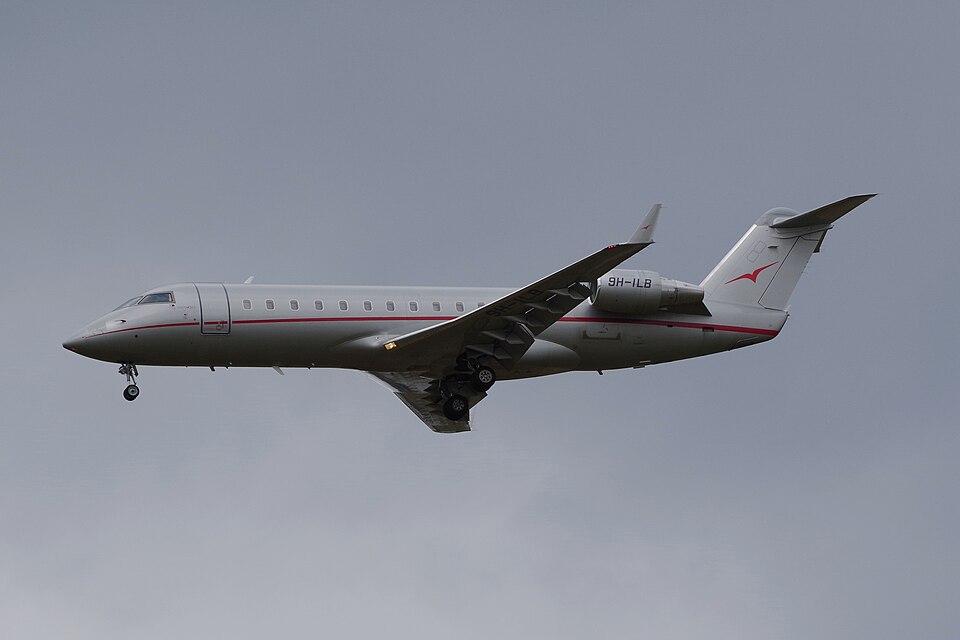
On December 18, 2020, a BOMBARDIER CL-600-2B19 (registration 9H-ILB) was involved in an aviation accident near Sion Aéroport (LSGS), VS, CH. This summary draws on records from the Swiss Transportation Safety Investigation Board (STSB / SUST); 3 related events involving the same aircraft type or operator are linked below.
On 18 Dec 2020, a Bombardier CL-600-2B19 (9H-ILB) and a Diamond DA-40 (HB-SDV) had a Category B airprox 16 NM ENE of Sion, Switzerland, at 12,500 ft in Class E airspace.
Incident Overview and Location On 18 December 2020, a dangerous proximity (airprox) occurred between two aircraft in Swiss airspace. The incident took place approximately 16 nautical miles (30 km) east-northeast of Sion, Valais, at an altitude of about 12,500 feet above mean sea level. The coordinates were 621 400 / 132 600 in the Swiss Grid 1903 system. The event was classified as an ICAO Category B airprox, with a minimum separation of 100 feet vertically and 1.1 nautical miles horizontally. The airspace was Class E, and no minimum separation was prescribed between IFR and VFR traffic in that airspace. ## Aircraft and Operations The first aircraft was a Bombardier CL-600-2B19, known as the Challenger 850, with the registration 9H-ILB. It was owned and operated by VistaJet Limited of Malta and was flying under Instrument Flight Rules (IFR) as a business flight. The aircraft was on an instrument approach to Sion Airport (LSGS) from Kortrijk-Wevelgem (EBKT) in Belgium. The pilot-in-command was a Dutch national born in 1975, holding an EASA ATPL(A) license issued by the German LBA, with 5,800 total flight hours and 2,400 hours on type. The aircraft was equipped with a transponder and TCAS. The second aircraft was a Diamond DA-40 NG with the registration HB-SDV, owned by Avilù SA of Agno, Switzerland. It was a private flight under Visual Flight Rules (VFR) from Lausanne (LSGL) to Lugano (LSZA). The pilot was an Italian national born in 1964, holding an ATPL(A) issued by the Swiss BAZL, with 8,100 total flight hours and 50 hours on type. The aircraft was equipped with a transponder. ## Sequence of Events The Diamond DA-40 departed Lausanne around midday and intended to fly southward through the Rhone Valley near the Sion TMA. At 12:05:25 UTC, the pilot contacted the Geneva Flight Information Service. The Bombardier was on an instrument approach to Sion, descending southwestward into the Sion TMA, which was not active at the time. The Sion control tower provided traffic information to the Bombardier about the VFR traffic at 1 o'clock, 7 miles, 13,000 feet, proceeding southbound. The Geneva FIS also informed the Diamond DA-40 pilot about the IFR jet at 10 o'clock, 4 miles, 1,400 feet above, in descent to Sion. At 12:22:58 UTC, the TCAS on the Bombardier issued a Resolution Advisory (RA) to climb. The crew complied and initiated a climb. Simultaneously, the Diamond DA-40 pilot reported seeing the jet and stated they would climb a little. Both aircraft continued to climb and approach each other. At 12:23:15 UTC, the Diamond DA-40 pilot stated they had to descend because the jet was also climbing. At that point, the separation was 100 feet vertically and 1.1 nautical miles horizontally. The vertical separation then increased to 375 feet at 0.7 nautical miles and 900 feet at 0.1 nautical miles. ## Weather and Airspace Conditions Weather conditions had no influence on the incident. The sky was clear over the Rhone Valley with visibility of at least 70 km. At 12,500 feet, the wind was from the southwest at 20 knots with a temperature of -10 °C. The QNH at Sion was 1025 hPa. The Sion Airport has a Class D TMA that can be activated temporarily to protect IFR arrivals. In this case, the TMA was not active, so the airprox occurred in Class E airspace. The Sion TMA is designated as a 'TMA TEMPO' and is activated by prior publication via NOTAM and DABS, unlike other temporary TMAs that can be activated by radio. This arrangement stems from the airport's former military use. Since 2022, Sion has been a purely civilian airport, but the airspace structure had not yet been adjusted. ## Similar Incidents The report notes that dangerous proximities between IFR and VFR traffic in the Sion TMA area, when the TMA is not active, occur repeatedly. The source mentions comparable recent incidents that are largely identical to this case, though the specific details of those examples are cut off in the provided text.