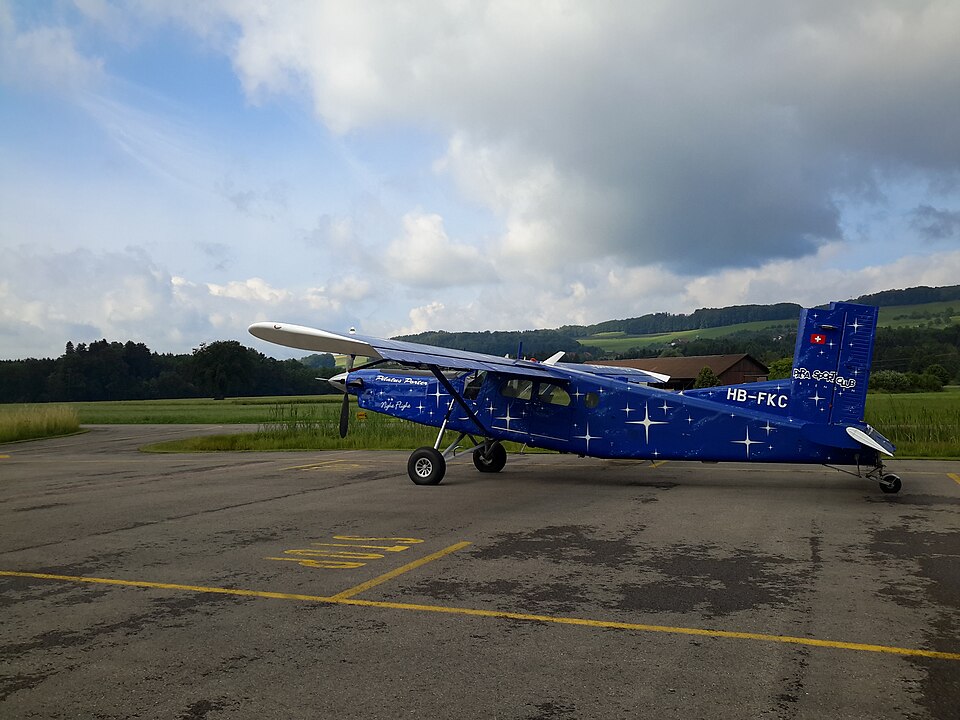
Accident Details
On 5 March 1994, a Pilatus PC-6/B2-H4, registration HB-FKC, operated by Para-Sport-Club Triengen, was conducting a commercial flight to drop parachutists at Wangen-Lachen airfield. After two previous drops, nine parachutists boarded for a third drop. The pilot aligned the aircraft on runway 08 and performed pre-takeoff checks, including locking the tailwheel as confirmed by rudder input.
During the takeoff roll, after approximately 100 meters in a three-point attitude, the aircraft veered left. The pilot applied full right rudder but could not correct the deviation. The aircraft left the runway, the main wheels lifted, and the tailwheel left a track that increasingly diverged from the runway centerline. Approaching a reed belt about 80 meters from the runway, the aircraft was in a high pitch attitude, barely airborne. The pilot decided to continue and attempt to clear the obstacle, but struck a bush protruding above the reeds. The collision damaged the propeller, landing gear, and horizontal stabilizer. The aircraft touched down in shallow water 30 meters beyond the obstacle. All nine parachutists and the pilot were uninjured.
Findings and Assessment
Investigation revealed that the pilot held a valid limited professional pilot license, had extensive flying experience, and was familiar with the airfield. The aircraft was certified for commercial daytime VFR operations, and weight and center of gravity were within limits. Before the flight, the tailwheel shock strut was observed to be nearly fully compressed due to oil loss, lowering the tail approximately 20 centimeters below normal. This condition increased the aircraft's angle of attack during the ground roll, causing it to become airborne at a lower speed with reduced control authority. The rudder trim was set to 3° right, and the elevator trim was within the green range.
Weather conditions were clear with visibility over 20 kilometers, temperature 11°C, and variable wind around 3 knots. The runway was asphalt, 500 meters long and 18 meters wide.
The aircraft's inherent directional stability with a locked tailwheel in three-point attitude should have prevented a veer, but the pilot likely did not correct an initial deviation sufficiently. Once the deviation exceeded a certain threshold, full rudder input could not restore direction. The low tailwheel position exacerbated the situation by reducing control effectiveness at the lower lift-off speed. After losing control, the pilot's decision to continue over the reed belt was considered appropriate, as aborting might have led to more severe consequences.
Probable Cause
The accident was caused by loss of control during the takeoff phase.