Introduction
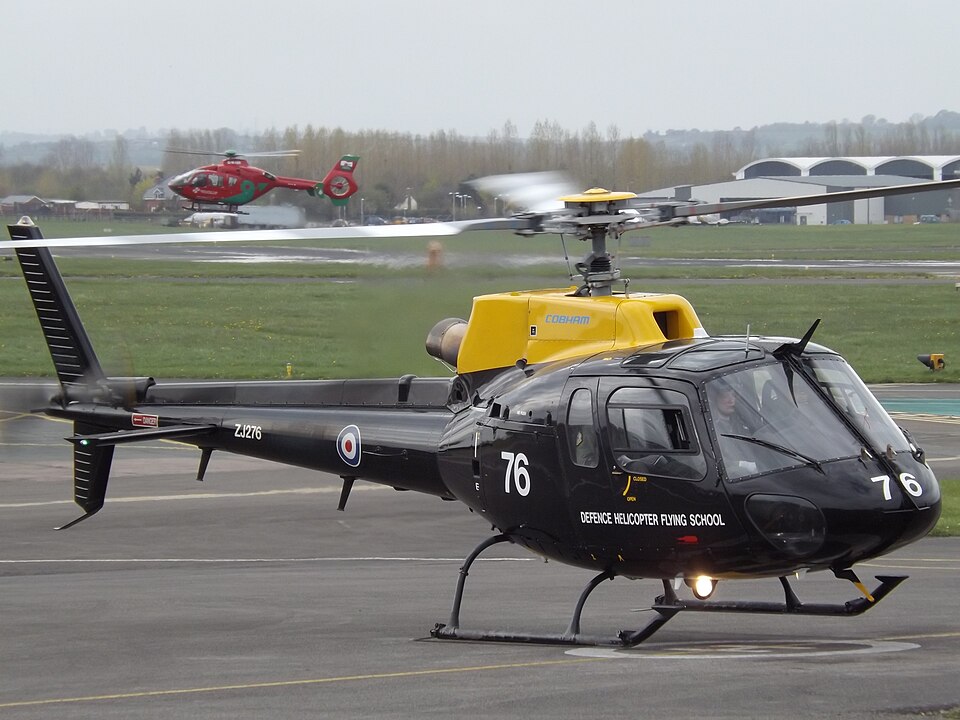
On 20 April 2012, a Squirrel HT1 helicopter, registration ZJ276, operated by the Defence Helicopter Flying School (DHFS) from RAF Shawbury, was conducting a solo student sortie as part of the Single Engine Rotary Wing syllabus. The sortie involved a transit to Chetwynd field, an MOD-owned site approximately 10 miles east of RAF Shawbury, where a series of Quick Stop (QS) manoeuvres were to be performed before returning to base.
Background
The student pilot, who had accumulated 32 hours 55 minutes of flying time on the DHFS course, had flown a dual QS sortie earlier that day and received a combined debrief and brief for the solo sortie. The aircraft took off from RAF Shawbury at 1507 hours local time and joined Chetwynd, where the landing direction was 260°. The student pilot conducted several QS manoeuvres, both into wind (ITW) and downwind (DW), in Area Right of the field.
First Impact
At 1546 hours, the student pilot positioned for a DW Flare and Turn QS. During the final stages of the manoeuvre, a rate of descent (RoD) built up and the aircraft unexpectedly impacted the ground. The impact occurred with low forward speed but significant vertical speed. Shortly after impact, an audio warning horn sounded for approximately 2.5 seconds, and the pilot saw an indication on the centralised warning panel. The aircraft remained on the ground for about 10 seconds before the pilot lifted it into a hover and transitioned to forward flight.
Second Impact
The student pilot elected to continue the sortie and conducted a standard 500-foot oval circuit for an ITW QS. At 1550 hours, he initiated the entry. During the manoeuvre, the freewheel unit activated intermittently. In the final stages, a rate of descent developed. Suspecting vortex ring, the pilot attempted to gain forward airspeed by adopting a nose-down attitude with the cyclic and lowering the collective lever. As height decreased, he adopted a landing attitude in anticipation of impact. At 1551 hours, the aircraft impacted the ground again. The horn sounded for 1.7 seconds. The aircraft came to rest upright with the underside of the cockpit touching the ground.
Post-Accident Events
The student pilot shut down the engine using both normal and emergency shut-off procedures but did not apply the rotor brake. Once rotor blades slowed, he egressed via the right-hand main door. He was uninjured. He used his personal mobile phone at 1555 hours to inform the DHFS Executive Flying Supervisor of a 'heavy landing'. A passing member of the public checked on the pilot and confirmed that assistance had been summoned. Ternhill attempted to contact the aircraft, but a civilian helicopter reported that the aircraft was on the ground. The Ternhill fire crew was dispatched at 1610 hours.
Aircraft Damage
The aircraft was assessed as Cat 4. The tail pylon failed at the transportation joint, and the vertical stabiliser with stinger fractured. The tail rotor gearbox mounting support fractured, and one of the two tail rotor blades failed at the blade root end, separating from the aircraft and coming to rest 20 meters to the left. The port baggage access panel and starboard crew door were open. The undercarriage was severely damaged: the forward support assembly distorted the underside of the airframe, forward support struts collapsed, the starboard skid forward vertical strut sheared near the skid attachment point, and the port skid forward vertical strut failed at the upper attachment point. The front of the starboard skid prevented the starboard door from closing, and the front of the port skid obstructed the port door. All transparencies were intact. Main rotor blades remained attached and appeared undamaged. The rotor brake lock was in the flight position, and the rotor brake lever was off. There was no post-crash fire.