Background
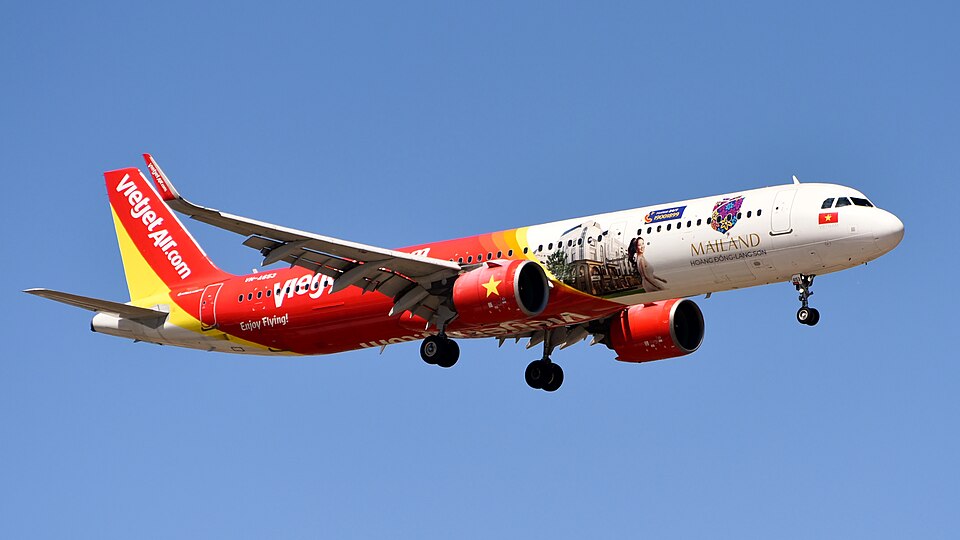
On 2 April 2022, Vietjet Air flight VJ380, an Airbus A321-271N with registration VN-A653, was operating from Tan Son Nhat International Airport to Phu Cat Airport. The aircraft was powered by two Pratt & Whitney PW1133GA-JM engines (engine 1 serial P771120, engine 2 serial P770749). The flight crew comprised a captain (born 1980) and a first officer (born 1992). There were 195 passengers and 7 crew members on board.
Flight Sequence
The aircraft departed Tan Son Nhat at 08:45 UTC. During climb and cruise, the ECAM displayed intermittent "ENG(2) START VALVE FAULT – START VALVE NOT CLOSED" cautions between 08:47 and 08:55 UTC, each lasting 10-13 seconds. The crew did not take specific action as the caution self-canceled. At 09:27, the crew reported established on the localizer for Runway 33 at Phu Cat. At 09:32 UTC, while at about 800 ft radio altitude, an "ENGINE 2 FIRE" warning appeared on ECAM. The first officer declared MAYDAY with "ENGINE FIRE". The crew continued the approach and landed safely at 09:33 UTC on Runway 33, using full reverse thrust on both engines.
Post-Landing Actions
After stopping on the runway, the engine 2 fire warning continued. The crew executed ECAM procedures and discharged one fire bottle into engine 2. They requested fire trucks and maintenance personnel to inspect the engine. After air traffic control confirmed no danger, the aircraft taxied to parking position using engine 1, with two fire trucks following. All passengers and crew evacuated safely without injuries.
Investigation Findings
Initial ground inspection of engine 2 revealed:
- The starter air duct was twisted and deformed.
- The air turbine starter was damaged.
- The start air valve was stuck partially open.
- The heat shield inside the right engine nacelle showed damage from metal debris.
Further teardown examination found:
- The high pressure valve (HPV) seal clip and butterfly seal were missing.
- Metal particles were present in the starter lubricating oil but not in the engine gearbox.
The investigation concluded that a missing seal clip from the HPV became a foreign object in the high pressure air duct, causing the start air valve to jam partially open. This allowed continuous high-pressure hot air to drive the starter turbine, which twisted the starter air duct and overheated the turbine, generating metal particles. The continuous hot air discharge into the engine nacelle during the flight ultimately triggered the fire warning during the final approach.
Root Cause and Preventative Actions
Airbus and Pratt & Whitney identified the HPV failure as a manufacturing defect. Airbus issued Technical Follow Up (TFU) 36.11.00106 and planned a periodic replacement of the HPV seal clip every 2000 flight hours (AMM 36-11-51-00/400-806) to be formalized in August 2022. The Civil Aviation Authority of Vietnam (CAAV) required Vietjet to inspect HPV seals on all A321NEOs and issued Technical Directive CAAV-07-04-2022/R0 on 7 April 2022, mandating a software update for the engine control computers (PW1130G-JM and PW1133GA-JM) to detect an open start air valve in flight and alert the crew to shut off bleed air to prevent recurrence.