Incident Overview
An aircraft cruising at flight level 410 above a cloud layer near the jet stream experienced an in-flight upset. The autopilot was engaged and operating in Performance Management System (PMS) mode, which provided pitch guidance to maintain FL 410, roll guidance to the ailerons and spoilers, and autothrottle control to maintain .85 Mach (254 KIAS).
Sequence of Events
While in cruise, the aircraft encountered clear air turbulence, causing airspeed to fluctuate between .84 and .88 Mach. The PMS responded by moving the throttles forward and aft in an attempt to hold .85 Mach. During these autothrottle adjustments, the thrust of the number 4 engine decreased and stabilized at approximately 1.0 EPR, and airspeed began to decrease.
The flight engineer attempted to manually recover the number 4 engine thrust but did not close the bleed air valve before adjusting the number 4 throttle. The number 4 engine remained at approximately 1.0 EPR. As the aircraft slowed, the autopilot trimmed to maintain altitude and heading until the pilot disengaged it. At that time, the aircraft rolled and yawed to the right and entered an uncontrolled descent into the clouds.
Recovery and Damage
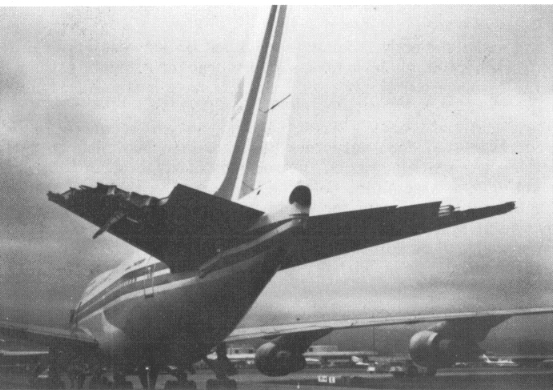
The crew regained control and leveled off at 9,500 feet after breaking out of the clouds at 11,000 feet. During the descent and recovery, the aircraft was damaged by acceleration forces and high speed.
Contributing Factors
There was evidence that the pilot was preoccupied with the engine problem, did not monitor instruments, and over-relied on the autopilot.