Background
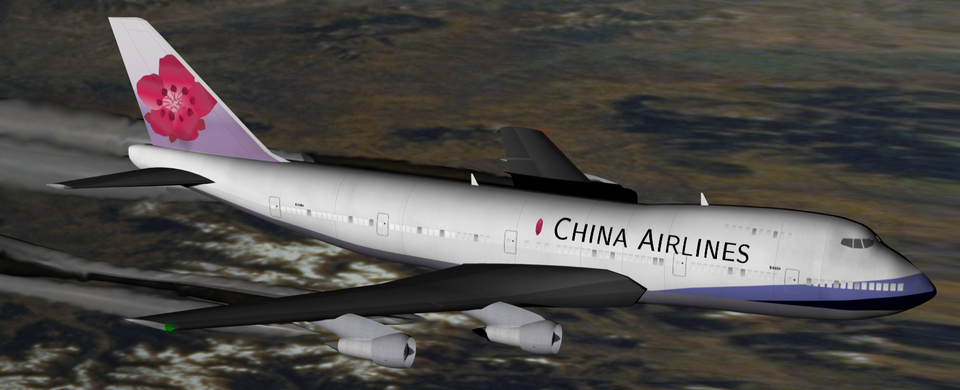
On May 25, 2002, China Airlines (CAL) Flight CI611, a Boeing 747-200 with Republic of China registration B-18255, was operating a regularly scheduled passenger flight from Chiang Kai Shek International Airport (CKS), Taoyuan, Taiwan, to Chek Lap Kok International Airport, Hong Kong. The aircraft was crewed by a captain, a first officer, a flight engineer, 16 cabin crew, and carried 206 passengers.
Accident
The flight crew reported for duty between 1305 and 1330 local time. The aircraft was prepared for departure, and at 1457:06 requested taxi clearance. At 1507:10, flight CI611 was cleared for takeoff on Runway 06 at CKS. Takeoff and initial climb were normal. At 1512:12, the flight engineer contacted China Airlines Operations with departure and estimated arrival information. At 1516:24, Taipei Area Control Center instructed the flight to climb to flight level 350 and proceed direct to KADLO. The crew acknowledged at 1516:31, the last radio transmission from the aircraft. Radar contact was lost at 1528:03. Search and rescue efforts began immediately; at 1800, floating wreckage was sighted 23 nautical miles northeast of Makung, Penghu Islands. The aircraft was totally destroyed and all 225 occupants were killed.
Investigation
The investigation found that the in-flight breakup occurred as the aircraft approached its cruising altitude. Evidence pointed to structural failure in the aft lower lobe section of the fuselage. On February 7, 1980, the accident aircraft had suffered a tail strike in Hong Kong. It was ferried back to Taiwan unpressurized the same day, and a temporary repair was conducted the next day. A permanent repair was performed from May 23 to 26, 1980.
Probable Cause
The investigation determined that the permanent repair was not accomplished in accordance with the Boeing Structural Repair Manual (SRM). The damaged skin in Section 46 was not removed (trimmed), and the repair doubler did not extend sufficiently beyond the entire damaged area to restore structural strength. Fatigue damage was found in the lower aft fuselage centered about STA 2100, between stringers S-48L and S-49L, under the repair doubler near its edge and outside the outer row of securing rivets. Multiple Site Damage (MSD) included a 15.1-inch through-thickness main fatigue crack and several small fatigue cracks, most initiating from scratching damage associated with the 1980 tail strike. Residual strength analysis indicated that the main fatigue crack combined with MSD could produce a continuous crack within a two-bay region (40 inches). The fuselage's residual strength would be compromised with a continuous crack of 58 inches or longer. The ASC believes that a continuous crack of at least 71 inches, a length sufficient to cause structural separation, was present before the in-flight breakup. Maintenance inspections of B-18255 did not detect the ineffective 1980 repair or the developing fatigue cracks. However, the time the fatigue cracks propagated through the skin thickness could not be determined.