History of the Flight
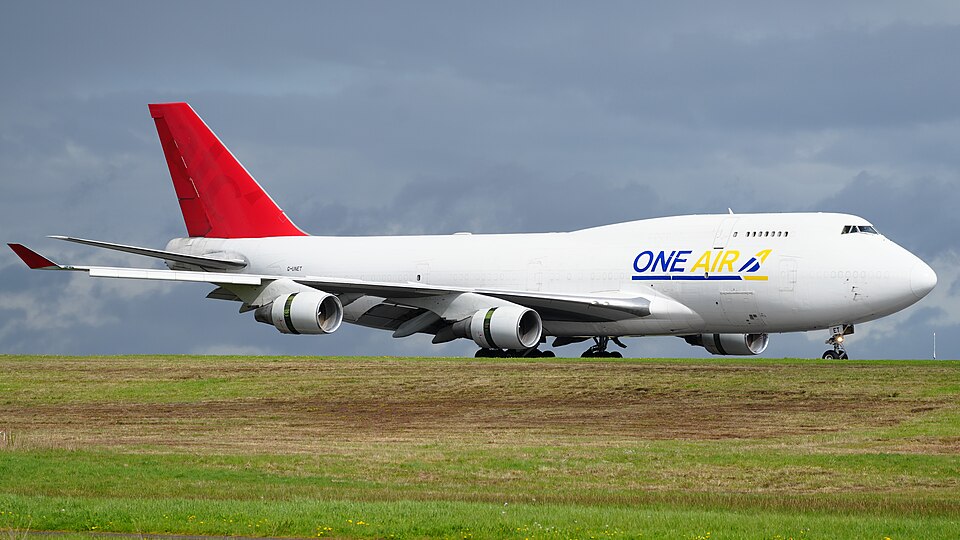
On 6 January 2024 at 1800 UTC, a Boeing 747-433 cargo aircraft, registration G-UNET, landed at London Heathrow Airport. The flight crew was unaware that a panel had detached from the left wing. The missing panel was identified during the subsequent turnaround. The aircraft operator filed a Mandatory Occurrence Report to the CAA but did not report it to the AAIB initially, as they did not consider it to meet the threshold for an accident or serious incident. The panel was found two months later, on 7 March 2024, in the grass area to the south of Runway 27L, approximately 600 m west of the runway threshold.
Examination of the Panel
The detached panel had maximum dimensions of 1.1 m by 0.9 m. It was identified as having detached from the upper left wing, adjacent to the outboard edge of spoiler 5. The panel exhibited a structural failure at its forward edge, revealing internal honeycomb, and a structural failure at its inboard rib. The outboard edge had detached from a line of rivets. The rib along the inboard edge showed evidence of previous repairs. The panel part number was 65B11629, and the rib part number was 65B10865.
Service Letter to Address Wing Panel Detachments
On 30 November 2010, the aircraft manufacturer published Service Letter (SL) 747-SL-57-101-B, titled 'Fixed Trailing Edge – Spoiler Support Revision at WBL 255.692 and WBL 432.6504'. The SL stated that operators had reported cracks in fixed trailing edge ribs, including part number 65B10865. It noted that cracks typically originate from the rib lower chord just aft of the diagonal tie rod fitting and propagate upwards. Continued crack growth can cause complete fracture of the rib, and in cases of complete rib fracture, the upper fixed trailing edge panel can become damaged. The SL indicated that such panel departures were not considered safety-related and did not significantly affect controllability. The SL explained that for improved aerodynamic performance, the 747-400 wing was designed to flex more than earlier models, increasing loads on the ribs. The SL recommended adjusting spoiler support rib clearances to mitigate cracking.
Aircraft Operator Action
The aircraft operator stated it was not aware of any specific task having been carried out on G-UNET concerning the Service Letter. After the left wing panel failure, the operator tasked their maintenance organization to check the spoiler support rib clearances on G-UNET's right wing against the SL; they were found to be within limits with no adjustments required. The operator also stated that the failed rib would have been inspected during wing zonal inspections carried out during A-checks at 1,000 flight hour intervals.
Information from the Aircraft Manufacturer
The aircraft manufacturer provided data on ten previous detachments of panels with the same part number: eight found during walkaround inspections after landing, one on approach (spotted by the control tower), and one during departure (the crew felt a shudder). Additionally, one panel was found cracked during a D-check. The manufacturer conducted an analysis of the effects of a fixed trailing edge upper wing panel departing the aircraft, considering four failure modes: impact on the aircraft causing loss of continued safe flight, fuselage penetration causing injury or depressurisation, impact on a person on the ground, and runway foreign object debris (FOD). The potential for loss of continued safe flight, occupant injury or depressurisation, and risk to persons on the ground were all assessed as 'not to be a safety concern'. The most likely hazard was runway FOD, which could damage another aircraft, but this was also considered 'not to be a safety concern' due to existing airport FOD mitigation initiatives and aircraft design standards.
Foreign Object Detection at Heathrow Airport
Heathrow Airport was equipped with a FOD radar detection system, which the airport operator stated was sensitive enough to detect small objects. However, the system only scans hard surfaces of the runways and would not have detected the wing panel in the grass area. The airport also had Surface Movement Radar, but it was not sufficiently sensitive to detect the panel. The wing panel had detached on 6 January and was found on 7 March; the airport operator noted that because it was winter, the grass was mown less frequently, otherwise the part would have been found sooner.
Analysis
The left wing panel was found 600 m beyond the threshold for Runway 27L, indicating it probably detached after touchdown when the spoilers were deployed. The panel most likely cracked and failed at its supporting rib first, before failing at the leading edge honeycomb structure. The aircraft manufacturer's Service Letter indicated that this rib was known to suffer from fatigue cracks and failures. There was no documentary evidence that the mitigating actions in the SL had been carried out on the incident aircraft; however, when the opposite right wing was checked, the clearances were within the limits of the SL.