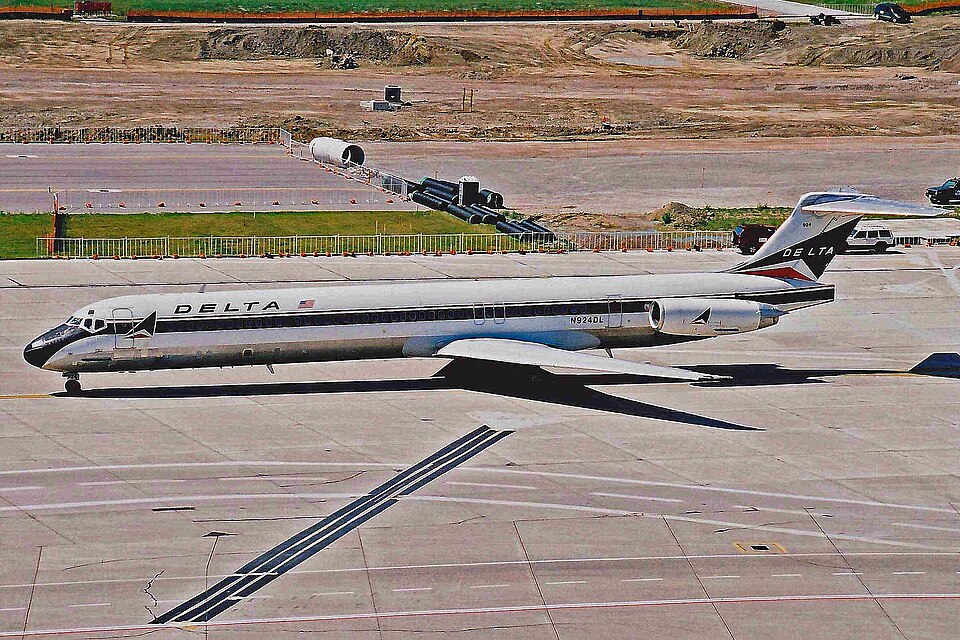
On August 1, 1988, a Mcdonnell Douglas MD-88 (registration N924DL) was involved in an aviation accident near Pensacola, FL. Investigators recorded the probable cause as: The pilot's failure to maintain proper airspeed during the final approach, which resulted in a high-speed touchdown and subsequent runway overrun. This summary draws on records from the U.S. National Transportation Safety Board (NTSB) historical archive.
The aircraft touched down well beyond the intended zone at excessive speed, exceeding its stopping capability and overrunning the end of runway 16.
What happened
The captain reported crossing the final approach fix at an altitude of 3000 feet while continuing the descent for landing. The aircraft made contact with the pavement at a groundspeed of 140 knots, which was significantly higher than the target reference speed. Witnesses and tower personnel confirmed that the aircraft touched down south of the intersection for runways 7-25, with approximately 3000 feet of runway remaining before the end.
Despite the remaining distance, the pilot was unable to bring the plane to a halt within the paved surface. The aircraft continued its momentum past the end of runway 16, resulting in an overrun incident. The landing card indicated that the reference landing speed (Vref) for this specific approach should have been 128 knots, highlighting a substantial deviation from standard operating procedures.
Probable cause
The pilot's failure to maintain proper airspeed during the final approach, which resulted in a high-speed touchdown and subsequent runway overrun.
A SkyWalk Join't 3 paraglider crashed into the ground near Las Vizcachas, Chile, on September 1, 2024. The pilot and passenger sustained serious spinal…
PARAPENTE (ULTRALIVIANO NO MOTORIZADO)·2024-09-01DGAC Chile
A Cessna 172N struck electrical cables while on final approach to land at Aucó Aerodrome in Chile. The pilot was uninjured, but the aircraft sustained damage…
A Bombardier DHC-8-402 suffered a tail strike during landing at Puerto Williams on September 9, 2024. All 76 occupants were unharmed, but the aircraft…
A MYD JS-MD 3 glider veered off the runway and struck a wall at Vitacura Aerodrome on January 6, 2025. The pilot was uninjured, but the aircraft sustained…
A recreational paraglider flight in Puchuncaví, Chile, ended with the pilot sustaining serious injuries after a rapid descent and impact with a hillside on…
PARAPENTE (ULTRALIVIANO NO MOTORIZADO)·2025-03-29DGAC Chile
A Tecnam P2006T landed on its belly at an aerodrome in Poland after the crew failed to confirm landing gear deployment. The incident resulted in no injuries…