Casualties unknown

Aircraft Strikes Cables During Localizer Back Course Approach, Lands Safely (N283AU)

Kansas City, MO, US

On September 9, 1989, a Boeing 737-200A (registration N283AU) operated by Usair was involved in an aviation accident near Kansas City, MO. Investigators recorded the probable cause as: The safety board found that the crew did not adequately review approach charts; the first officer misidentified lights on the ground which influenced the captain's subsequent misidentification; ATC failed to provide accurate weather to the crew, failed to… This summary draws on records from the U.S. National Transportation Safety Board (NTSB) historical archive; 10 related events involving the same aircraft type or operator are linked below.

Sourcesthe U.S. National Transportation Safety Board (NTSB) historical archivePrimary reportUpdated 2026-06-10Data APIEditorial standards
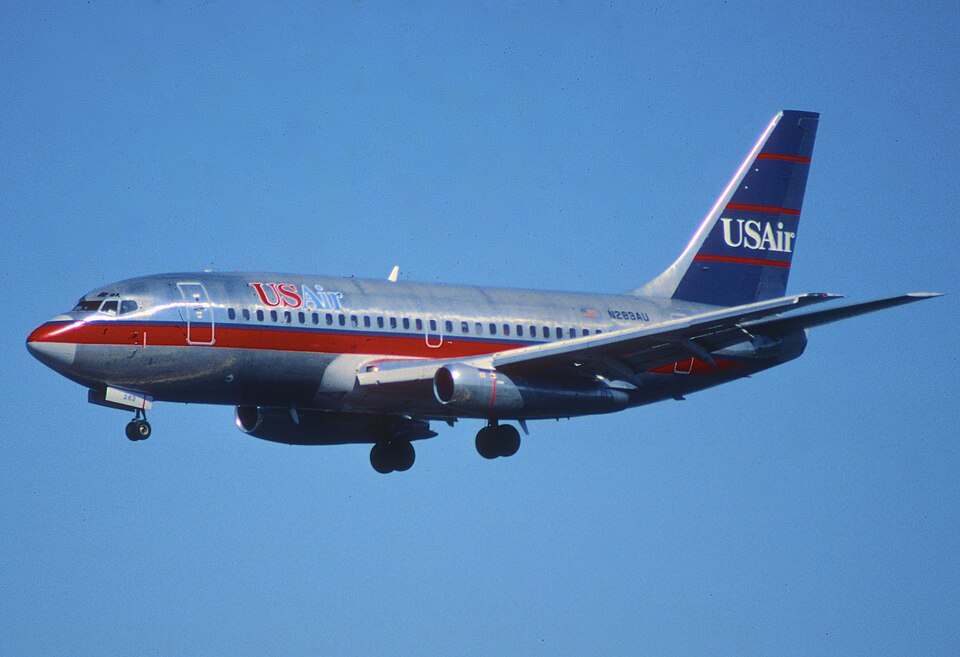
Aircraft registered N283AU
Aircraft registered N283AU. Photo: Aero Icarus from Zürich, Switzerland / CC BY-SA 2.0, via Wikimedia Commons

An airplane struck four electronic transmission cables 75 ft AGL and 7,000 ft short of the runway during a localizer back course approach. The crew executed a missed approach and landed uneventfully in Salina, KS.

Incident Overview

During a localizer back course approach to Runway 27, an airplane collided with four electronic transmission cables. The cables were located 75 feet above ground level (AGL), approximately 7,000 feet short of the runway threshold. After the collision, the crew executed a missed approach and subsequently landed without further incident in Salina, Kansas.

Findings of the Safety Board

The National Transportation Safety Board (NTSB) identified several factors contributing to the event. The crew did not adequately review approach charts. The first officer misidentified lights on the ground, which influenced the captain's subsequent misidentification. Air traffic control (ATC) failed to provide accurate weather information to the crew and failed to vector the airplane to join the localizer outside the final approach fix. Additionally, ATC committed other errors in handling the flight.

An FAA inspector, who was conducting an en route inspection of the flight, did not inform the crew of the errors they were committing in the planning and execution of the approach. The crew did not execute a missed approach when they encountered full-scale localizer deflection inside the final approach fix.

Probable cause

The safety board found that the crew did not adequately review approach charts; the first officer misidentified lights on the ground which influenced the captain's subsequent misidentification; ATC failed to provide accurate weather to the crew, failed to vector the airplane to join the localizer outside the final approach fix and committed other errors in handling the flight; an FAA inspector conducting an en route inspection did not inform the crew of the errors they were committing in the planning and execution of the approach; and the crew did not execute a missed approach when they encountered full-scale localizer deflection inside the final approach fix.

Investigation report by the U.S. National Transportation Safety Board (NTSB) historical archive. Original record: https://carol.ntsb.gov/event/20001213X29334. This page is a structured re-presentation; facts and quotes are in the National Transportation Safety Board (NTSB), United States.