Accident Overview
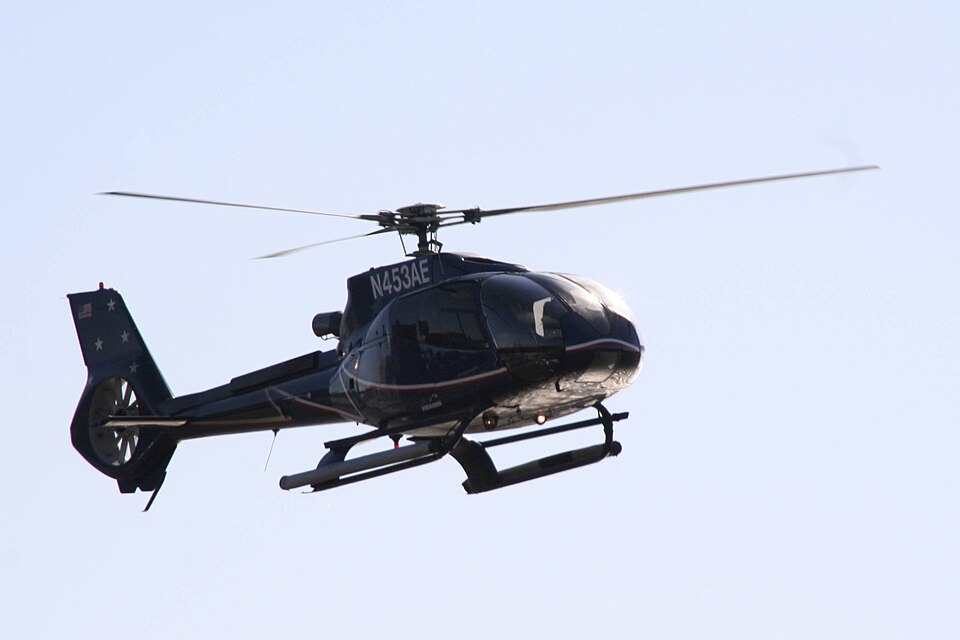
A helicopter operated on a revenue sightseeing flight experienced a main rotor blade fracture approximately 8 minutes into the flight, while at an altitude of 350–400 feet above the Hudson River and on approach to land. A 20-inch section of the composite main rotor blade's trailing portion, aft of the spar, separated from the blade. The pilot reported an immediate decay in main rotor speed accompanied by a prominent and abnormal vibration. She observed a piece of debris, likely the liberated blade section, fly from the left rear of the helicopter forward past the cabin. The pilot executed an emergency autorotation onto the water after activating the emergency float system. The helicopter landed upright on its floats; however, the main rotor blades struck the water and the tail boom, resulting in substantial damage to the tail boom. The occupants were rescued by boaters and were not injured.
Examination of the Main Rotor Blade
Detailed examination of the helicopter revealed no evidence of flight control system component failures or malfunctions other than the main rotor blade fracture. The main rotor blades (part number 355A-11-0030) were constructed from glass fiber reinforced composite material with a foam core. The blade structure includes a spar, wedge-shaped foam core, trailing edge roving, and trailing edge tab sandwiched between skin layers and skin reinforcement layers. The skin, skin reinforcement, and trailing edge tab layers are made with glass fabric reinforcement, while the trailing edge roving consists of unidirectional glass fibers aligned approximately parallel with the spanwise direction of the blade.
The fractured main rotor blade was examined at the manufacturer's facility under the oversight of France's Bureau of Investigation and Analysis (BEA), and results were reviewed by the NTSB Materials Laboratory. The NTSB Materials Laboratory also examined sectioned pieces of the blue and yellow main rotor blades submitted by Eurocopter. Physical and microscopic examination showed that the fracture was due to fatigue cracks that initiated near the trailing edge of the blade near blade station 1300. The fatigue cracking most likely resulted from out-of-specification deviations in the alignment of the trailing edge roving fibers within a transition region where the trailing edge roving shifts toward the trailing edge and where skin reinforcement layers end.
Fiber Deviation and Fatigue Mechanism
In the areas of the deviations, the unidirectional fibers of the roving were not properly aligned with the spanwise direction of the blade, likely causing localized changes in stiffness at the trailing edge. With this fiber misalignment, some longitudinal stresses normally carried by the roving layers would be shed to adjacent skin and trailing edge tab areas, potentially leading to fatigue cracking in these adjacent layers. Undamaged fracture features in the trailing edge roving of the blue main rotor blade section showed fiber fractures with mirror fracture surfaces across the fiber diameters, indicating they were substantially weakened when they fractured. The mirror fractures could be evidence of progressive fracture through the trailing edge roving due to fatigue or environmental attack.
The overall fracture surface was relatively rough and did not form a flat plane typical of tensile fatigue fracture, as observed in some skin areas. Some fibers exhibited steps on one or both sides of the fracture, suggesting a mixed mode of loading including tension and transverse shear, which could explain the roughness. As cracking progresses, matrix material surrounding the fibers cracks, allowing environmental exposure that could weaken the fibers. Fractographic evidence indicated the trailing edge roving was likely significantly weaker than expected. Weakening could occur due to mechanical damage during fatigue cracking or environmental attack; in either case, individual fiber strength was less than expected in a large area of the trailing edge roving.
The total extent of weakening is unknown due to post-fracture damage and the unknown extent of pre-fracture cracking in the trailing edge roving. In previous cases of skin cracking, an intact trailing edge roving was required to maintain crack stability. However, in this case the weakened condition of the trailing edge roving means previous cases cannot be used to assess crack stability. Given the extent of skin cracking and evidence of weakening, it is likely that cracking at the trailing edge of the blue blade had progressed to cause blade fracture.
Manufacturing and Inspection Issues
The deviation in the trailing edge roving fibers occurred during manufacture of the accident blade; it is likely that the trailing edge fibers shifted during the curing process. The skin layers are somewhat translucent after curing, and manufacturing records showed that the inspector who performed the visual examination after curing flagged the transition area of this blade for a radiographic inspection. It is possible the inspector observed an anomaly in the trailing edge roving; however, the out-of-specification deviations were not detected by the radiographic examination.
A record search of 9,761 similar blades revealed one other blade that had been flagged for radiographic inspection near blade station 1300 during visual examination and subsequently passed; that blade was examined and showed no significant deviations. The two other blades from the accident helicopter were also examined and showed no significant deviations from the as-designed position. The main rotor blade was rated for a service life of 20,000 hours, and the fracture occurred after about 8,077 hours. The manufacturer stated that prior to this event there had been no reported similar main rotor blade failures.